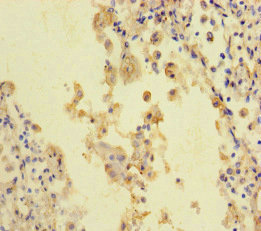
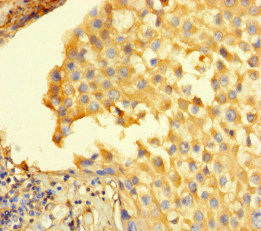
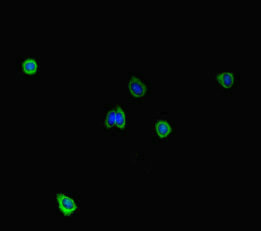
-
Chinese (Simplified)
-
English
-
German
-
Korean
-
Spanish
Chinese (Simplified)
English
German
Korean
Spanish
Sign up for an account to enjoy easy online shopping and instant order tracking.
The antibody against STIL was raised in rabbit using the Recombinant Human SCL-interrupting locus protein (388-637AA) as the immunogen. This antibody exists as a non-conjugated isotype IgG, purified by protein G with a purity greater than 95%. This antibody has been validated on ELISA, IHC, IF.
$299.00
| Cat.No | ADC-15439A | Clonality | Polyclonal |
|---|---|---|---|
| Host Species | Rabbit | Target Name | STIL |
| Form | Liquid | Species Reactivity | Human |
| Isotype | IgG | Storage Buffer | 0.01M PBS, 0.03% Proclin 300; Constituents: 50% Glycerol, PH 7.4 |
| Purification Method | >95%, Protein G purified | Conjugate | Non-conjugated |
| Application | ELISA, IF, IHC | Storage | Upon receipt |
| Immunogen Description | Recombinant Human SCL-interrupting locus protein (388-637AA) | Target Species | Human |
|---|---|---|---|
| Immunogen Sequence | Complete sequences for the immunogen, target protein, and peptides are available upon request. | Uniprot ID | Q15468 |
Uniprot Id
Q15468
Target Species
Human
Target Name
STIL
Target Full Name
SCL-interrupting locus protein
Target Function
Immediate-early gene. Plays an important role in embryonic development as well as in cellular growth and proliferation; its long-term silencing affects cell survival and cell cycle distribution as well as decreases CDK1 activity correlated with reduced phosphorylation of CDK1. Plays a role as a positive regulator of the sonic hedgehog pathway, acting downstream of PTCH1. Plays an important role in the regulation of centriole duplication. Required for the onset of procentriole formation and proper mitotic progression. During procentriole formation, is essential for the correct loading of SASS6 and CENPJ to the base of the procentriole to initiate procentriole assembly.
Target Involvement
Microcephaly 7, primary, autosomal recessive (MCPH7)
Target Subcellular Location
Cytoplasm, cytosol. Cytoplasm, cytoskeleton, microtubule organizing center, centrosome, centriole.
Target Tissue Specificity
Expressed in all hematopoietic tissues and cell lines. Highly expressed in a variety of tumors characterized by increased mitotic activity with highest expression in lung cancer.
Target Synonyms
DKFZp686O09161; MCPH7; OTTHUMP00000009566; SCL interrupting locus protein; SCL-interrupting locus protein; SCL/TAL1 interrupting locus; SIL; STIL; STIL_HUMAN; TAL 1 interrupting locus protein; TAL-1-interrupting locus protein
Target Background
This gene encodes a cytoplasmic protein implicated in regulation of the mitotic spindle checkpoint, a regulatory pathway that monitors chromosome segregation during cell division to ensure the proper distribution of chromosomes to daughter cells. The protein is phosphorylated in mitosis and in response to activation of the spindle checkpoint, and disappears when cells transition to G1 phase. It interacts with a mitotic regulator, and its expression is required to efficiently activate the spindle checkpoint. It is proposed to regulate Cdc2 kinase activity during spindle checkpoint arrest. Chromosomal deletions that fuse this gene and the adjacent locus commonly occur in T cell leukemias, and are thought to arise through illegitimate V-(D)-J recombination events. Multiple transcript variants encoding different isoforms have been found for this gene.
Notification