-
Chinese (Simplified)
-
English
-
German
-
Korean
-
Spanish
Chinese (Simplified)
English
German
Korean
Spanish
Sign up for an account to enjoy easy online shopping and instant order tracking.
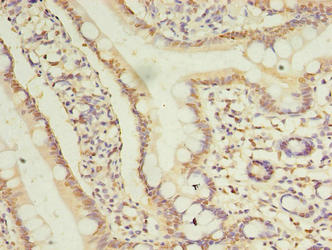
The antibody against TRIM15 was raised in rabbit using the Recombinant Human Tripartite motif-containing protein 15 protein (122-387AA) as the immunogen. This antibody exists as a non-conjugated isotype IgG, Antigen affinity purified. This antibody has been validated on ELISA, WB, IHC.
$299.00
| Cat.No | ADC-22350A | Clonality | Polyclonal |
|---|---|---|---|
| Host Species | Rabbit | Target Name | TRIM15 |
| Form | Liquid | Species Reactivity | Human |
| Isotype | IgG | Storage Buffer | 0.01M PBS, 0.03% Proclin 300; Constituents: 50% Glycerol, PH 7.4 |
| Purification Method | Antigen affinity purified | Conjugate | Non-conjugated |
| Application | ELISA, IHC, WB | Storage | Upon receipt |
| Immunogen Description | Recombinant Human Tripartite motif-containing protein 15 protein (122-387AA) | Target Species | Human |
|---|---|---|---|
| Immunogen Sequence | Complete sequences for the immunogen, target protein, and peptides are available upon request. | Uniprot ID | Q9C019 |
Uniprot Id
Q9C019
Target Species
Human
Target Name
TRIM15
Target Full Name
E3 ubiquitin-protein ligase TRIM15
Target Synonyms
HGNC:16284; RING finger protein 93; TRI15_HUMAN; TRIM15; Tripartite motif containing 15; Tripartite motif protein 15; Tripartite motif-containing protein 15; Zinc finger protein 178; Zinc finger protein B7; ZNF178; ZNFB7
Target Background
The protein encoded by this gene is a member of the tripartite motif (TRIM) family. The TRIM motif includes three zinc-binding domains, a RING, a B-box type 1 and a B-box type 2, and a coiled-coil region. The protein localizes to the cytoplasm. Alternatively spliced transcript variants have been described, but their biological validity has not been determined.
Notification