-
Chinese (Simplified)
-
English
-
German
-
Korean
-
Spanish
Chinese (Simplified)
English
German
Korean
Spanish
Sign up for an account to enjoy easy online shopping and instant order tracking.
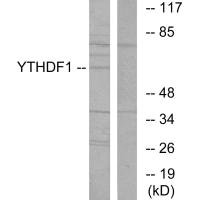
The antibody against YTHDF1 was raised in rabbit using the Synthesized peptide derived from N-terminal of Human YTHDF1. as the immunogen. The antibody was affinity-purified from rabbit antiserum by affinity-chromatography using epitope-specific immunogen. This antibody has been validated on ELISA, WB.
$297.00
| Cat.No | ADC-41818A | Clonality | Polyclonal |
|---|---|---|---|
| Host Species | Rabbit | Target Name | YTHDF1 |
| Form | Liquid | Species Reactivity | Human, Mouse, Rat |
| Storage Buffer | PH 7.4, 0.02% sodium azide and 50% glycerol., 150mM NaCl, Rabbit IgG in phosphate buffered saline (without Mg2+ and Ca2+) | Purification Method | The antibody was affinity-purified from rabbit antiserum by affinity-chromatography using epitope-specific immunogen. |
| Application | ELISA, WB | Storage | Upon receipt |
| Immunogen Description | Synthesized peptide derived from N-terminal of Human YTHDF1. | Target Species | Human |
|---|---|---|---|
| Immunogen Sequence | Complete sequences for the immunogen, target protein, and peptides are available upon request. | Uniprot ID | Q9BYJ9 |
Uniprot Id
Q9BYJ9
Target Species
Human
Target Name
YTHDF1
Target Full Name
YTH domain-containing family protein 1
Target Function
Specifically recognizes and binds N6-methyladenosine (m6A)-containing mRNAs, and regulates their stability. M6A is a modification present at internal sites of mRNAs and some non-coding RNAs and plays a role in mRNA stability and processing. Acts as a regulator of mRNA stability by promoting degradation of m6A-containing mRNAs via interaction with the CCR4-NOT complex. The YTHDF paralogs (YTHDF1, YTHDF2 and YTHDF3) shares m6A-containing mRNAs targets and act redundantly to mediate mRNA degradation and cellular differentiation. Required to facilitate learning and memory formation in the hippocampus by binding to m6A-containing neuronal mRNAs. Acts as a regulator of axon guidance by binding to m6A-containing ROBO3 transcripts. Acts as a negative regulator of antigen cross-presentation in myeloid dendritic cells. In the context of tumorigenesis, negative regulation of antigen cross-presentation limits the anti-tumor response by reducing efficiency of tumor-antigen cross-presentation. Promotes formation of phase-separated membraneless compartments, such as P-bodies or stress granules, by undergoing liquid-liquid phase separation upon binding to mRNAs containing multiple m6A-modified residues: polymethylated mRNAs act as a multivalent scaffold for the binding of YTHDF proteins, juxtaposing their disordered regions and thereby leading to phase separation. The resulting mRNA-YTHDF complexes then partition into different endogenous phase-separated membraneless compartments, such as P-bodies, stress granules or neuronal RNA granules.
Target Subcellular Location
Cytoplasm. Cytoplasm, P-body. Cytoplasm, Stress granule.
Target Research Area
Cell Biology
Target Synonyms
C20orf21; DACA 1; DACA-1; Dermatomyositis associated with cancer putative autoantigen 1; YTH domain family 1; YTH domain family member 1; YTH domain family protein 1; YTHD1; YTHD1_HUMAN; Ythdf1
Target Background
Enables N6-methyladenosine-containing RNA binding activity and ribosome binding activity. Involved in mRNA destabilization; positive regulation of translational initiation; and stress granule assembly. Located in P-body and cytoplasmic stress granule.
Notification