-
Chinese (Simplified)
-
English
-
German
-
Korean
-
Spanish
Chinese (Simplified)
English
German
Korean
Spanish
Sign up for an account to enjoy easy online shopping and instant order tracking.
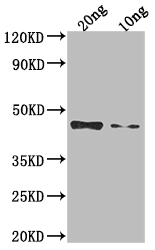
The antibody against Non-structural polyprotein was raised in rabbit using the Recombinant Venezuelan equine encephalitis virus (strain Trinidad donkey) (VEEV) Non-structural polyprotein (1-288aa) as the immunogen. This antibody exists as a non-conjugated isotype IgG, Protein G Purified. This antibody has been validated on ELISA, WB.
$299.00
| Cat.No | ADC-54677A | Clonality | Polyclonal |
|---|---|---|---|
| Host Species | Rabbit | Target Name | Non-structural polyprotein |
| Target Synonyms | mRNA-capping enzyme nsP1 (EC 2.1.1.-) (EC 2.7.7.-) (Non-structural protein 1), Non-structural polyprotein (Polyprotein nsP1234) (P1234) [Cleaved into: P123, Non-structural protein 3 (nsP3), P123', Protease nsP2 (EC 3.1.3.33) (EC 3.4.22.-) (EC 3.6.1.15) (EC 3.6.4.13) (Non-structural protein 2) (nsP2), RNA-directed RNA polymerase nsP4 (EC 2.7.7.48) (Non-structural protein 4) (nsP4)] | Form | Liquid |
| Species Reactivity | Venezuelan equine encephalitis virus (strain Trinidad donkey) (VEEV) | Isotype | IgG |
| Storage Buffer | 0.01M PBS, 0.03% Proclin 300; Constituents: 50% Glycerol, PH 7.4 | Purification Method | Protein G purified |
| Conjugate | Non-conjugated | Application | ELISA, WB |
| Storage | Upon receipt |
| Immunogen Description | Recombinant Venezuelan equine encephalitis virus (strain Trinidad donkey) (VEEV) Non-structural polyprotein (1-288aa) | Target Species | Venezuelan equine encephalitis virus (strain Trinidad donkey) (VEEV) |
|---|---|---|---|
| Immunogen Sequence | Complete sequences for the immunogen, target protein, and peptides are available upon request. | Uniprot ID | P27282 |
Uniprot Id
P27282
Target Species
Venezuelan equine encephalitis virus (strain Trinidad donkey) (VEEV)
Target Function
Inactive precursor of the viral replicase, which is activated by cleavages carried out by the viral protease nsP2.; The early replication complex formed by the polyprotein P123 and nsP4 synthesizes the minus-strand RNAs (antigenome). Polyprotein P123 is a short-lived polyprotein that accumulates during early stage of infection (Probable). As soon P123 is cleaved into mature proteins, the plus-strand RNAs synthesis begins.; The early replication complex formed by the polyprotein P123' and nsP4 synthesizes minus-strand RNAs (antigenome) (Probable). Polyprotein P123' is a short-lived polyprotein that accumulates during early stage of infection (Probable). As soon P123' is cleaved into mature proteins, the plus-strand RNAs synthesis begins (Probable).; Cytoplasmic capping enzyme that catalyzes two virus-specific reactions: methyltransferase and nsP1 guanylyltransferase. mRNA-capping is necessary since all viral RNAs are synthesized in the cytoplasm, and host capping enzymes are restricted to the nucleus (Probable). The enzymatic reaction involves a covalent link between 7-methyl-GMP and nsP1, whereas eukaryotic capping enzymes form a covalent complex only with GMP. NsP1 capping consists in the following reactions: GTP is first methylated into 7-methyl-GMP and then is covalently linked to nsP1 to form the m7GMp-nsP1 complex from which 7-methyl-GMP complex is transferred to the mRNA to create the cap structure. NsP1 is also needed for the initiation of the minus-strand RNAs synthesis. Probably serves as a membrane anchor for the replication complex composed of nsP1-nsP4. Nsp1 is needed for the initiation of the minus-strand RNAs synthesis. Palmitoylated nsP1 is remodeling host cell cytoskeleton, and induces filopodium-like structure formation at the surface of the host cell.; Multifunctional protein whose N-terminus is part of the RNA polymerase complex and displays NTPase, RNA triphosphatase and helicase activities. NTPase and RNA triphosphatase are involved in viral RNA capping and helicase keeps a check on the dsRNA replication intermediates. The C-terminus harbors a protease that specifically cleaves the polyproteins and releases the mature proteins. Required for the shutoff of minus-strand RNAs synthesis. Inhibits host translation to ensure maximal viral gene expression and evade host immune response.; Seems to be essential for minus-strand RNAs and subgenomic 26S mRNAs synthesis. Displays mono-ADP-ribosylhydrolase activity. ADP-ribosylation is a post-translational modification that controls various processes of the host cell and the virus probably needs to revert it for optimal viral replication. Binds proteins of FXR family and sequesters them into the viral RNA replication complexes thereby inhibiting the formation of host stress granules on viral mRNAs. The nsp3-FXR complexes bind viral RNAs and probably orchestrate the assembly of viral replication complexes, thanks to the ability of FXR family members to self-assemble and bind DNA.; Seems to be essential for minus-strand RNAs and subgenomic 26S mRNAs synthesis. Displays mono-ADP-ribosylhydrolase activity (Probable). ADP-ribosylation is a post-translational modification that controls various processes of the host cell and the virus probably needs to revert it for optimal viral replication (Probable). Binds proteins of FXR family and sequesters them into the viral RNA replication complexes thereby inhibiting the formation of host stress granules on viral mRNAs (Probable). The nsp3'-FXR complexes bind viral RNAs and probably orchestrate the assembly of viral replication complexes, thanks to the ability of FXR family members to self-assemble and bind DNA (Probable).; RNA dependent RNA polymerase. Replicates genomic and antigenomic RNA by recognizing replications specific signals. The early replication complex formed by the polyproteins P123/P123' and nsP4 synthesizes minus-strand RNAs. The late replication complex composed of fully processed nsP1-nsP4 is responsible for the production of genomic and subgenomic plus-strand RNAs.
Target Subcellular Location
[Polyprotein P1234]: Host cytoplasmic vesicle membrane; Peripheral membrane protein.; [Polyprotein P123']: Host cytoplasmic vesicle membrane; Peripheral membrane protein.; [Polyprotein P123]: Host cytoplasmic vesicle membrane; Peripheral membrane protein.; [mRNA-capping enzyme nsP1]: Host cytoplasmic vesicle membrane; Lipid-anchor. Host cell membrane; Lipid-anchor; Cytoplasmic side. Host cell projection, host filopodium.; [Protease nsP2]: Host cytoplasmic vesicle membrane; Peripheral membrane protein. Host nucleus. Host cytoplasm.; [Non-structural protein 3]: Host cytoplasmic vesicle membrane; Peripheral membrane protein.; [Non-structural protein 3']: Host cytoplasmic vesicle membrane; Peripheral membrane protein.; [RNA-directed RNA polymerase nsP4]: Host cytoplasmic vesicle membrane; Peripheral membrane protein.
Notification