-
Chinese (Simplified)
-
English
-
German
-
Korean
-
Spanish
Chinese (Simplified)
English
German
Korean
Spanish
Sign up for an account to enjoy easy online shopping and instant order tracking.
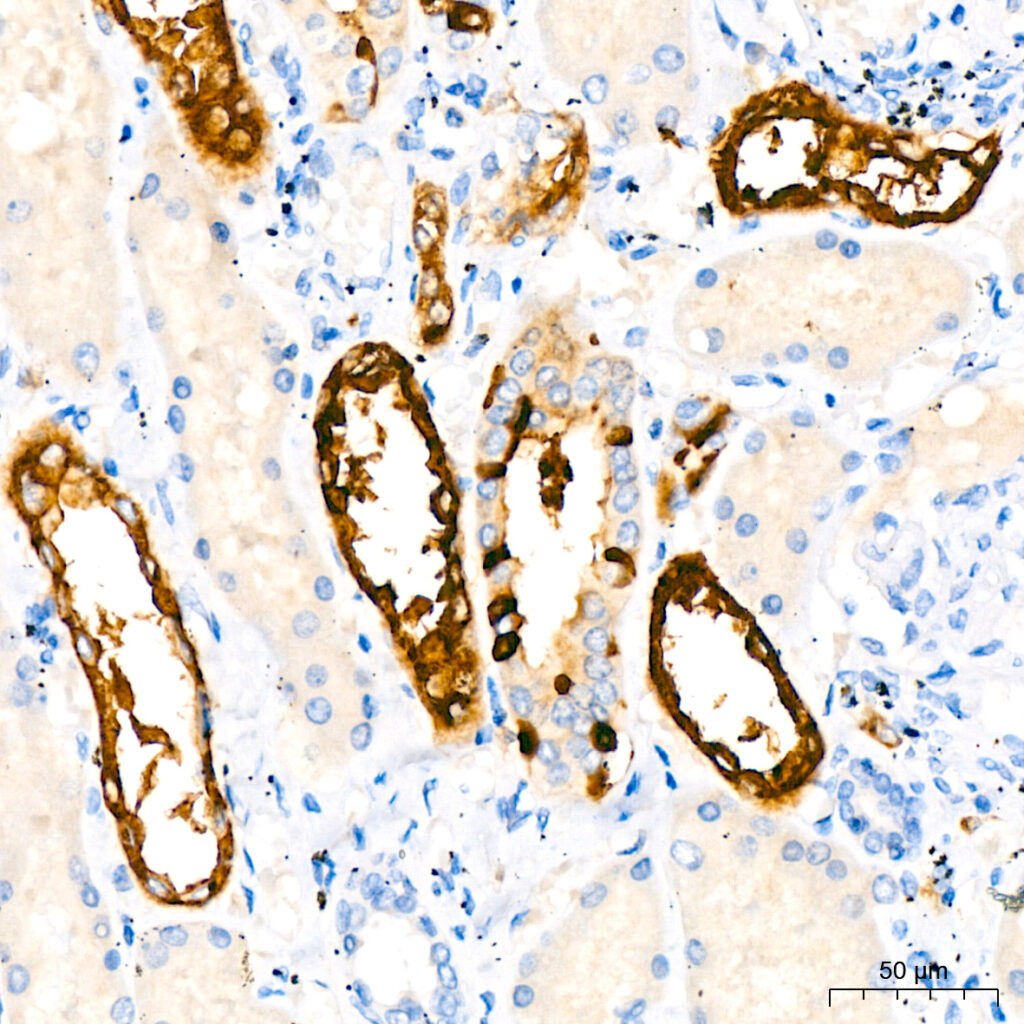
The antibody against Flt3/CD135 was raised in Rabbit using the recombinant fusion protein containing a sequence corresponding to amino acids 27-163 of human Flt3/CD135 (NP_004110.2) as the immunogen. The monoclonal antibody exists as a isotype IgG, by affinity purification. This antibody has been validated on IHC-P, FC, ELISA.
| Cat.No | ADA-15486A | Clonality | Monoclonal |
|---|---|---|---|
| Host Species | Rabbit | Target Name | Flt3/CD135 |
| Target Synonyms | FLK2; STK1; CD135; FLK-2; Flt3/CD135 | Form | Liquid |
| Species Reactivity | Human, Mouse, Rat | Isotype | IgG |
| Storage Buffer | 50% Glycerol, 0.05% BSA, PBS with 0.05% proclin300, pH7.3. | Purification Method | Affinity purification |
| Application | ELISA, FC, IHC-P |
| Immunogen Description | Recombinant fusion protein containing a sequence corresponding to amino acids 27-163 of human Flt3/CD135 (NP_004110.2). | Target Species | Human |
|---|---|---|---|
| Immunogen Sequence | NQDLPVIKCVLINHKNNDSSVGKSSSYPMVSESPEDLGCALRPQSSGTVYEAAAVEVDVSASITLQVLVDAPGNISCLWVFKHSSLNCQPHFDLQNRGVVSMVILKMTETQAGEYLLFIQSEATNYTILFTVSIRNT | Uniprot ID | P36888 |
Uniprot Id
P36888
Target Species
Human
Target Name
FLT3
Target Full Name
Receptor-type tyrosine-protein kinase FLT3
Target Function
Tyrosine-protein kinase that acts as cell-surface receptor for the cytokine FLT3LG and regulates differentiation, proliferation and survival of hematopoietic progenitor cells and of dendritic cells. Promotes phosphorylation of SHC1 and AKT1, and activation of the downstream effector MTOR. Promotes activation of RAS signaling and phosphorylation of downstream kinases, including MAPK1/ERK2 and/or MAPK3/ERK1. Promotes phosphorylation of FES, FER, PTPN6/SHP, PTPN11/SHP-2, PLCG1, and STAT5A and/or STAT5B. Activation of wild-type FLT3 causes only marginal activation of STAT5A or STAT5B. Mutations that cause constitutive kinase activity promote cell proliferation and resistance to apoptosis via the activation of multiple signaling pathways.
Target Involvement
Leukemia, acute myelogenous (AML)
Target Subcellular Location
Membrane; Single-pass type I membrane protein. Endoplasmic reticulum lumen. Note=Constitutively activated mutant forms with internal tandem duplications are less efficiently transported to the cell surface and a significant proportion is retained in an immature form in the endoplasmic reticulum lumen. The activated kinase is rapidly targeted for degradation.
Target Protein Families
Protein kinase superfamily, Tyr protein kinase family, CSF-1/PDGF receptor subfamily
Target Tissue Specificity
Detected in bone marrow, in hematopoietic stem cells, in myeloid progenitor cells and in granulocyte/macrophage progenitor cells (at protein level). Detected in bone marrow, liver, thymus, spleen and lymph node, and at low levels in kidney and pancreas. H
Target Research Area
Immunology
Target Synonyms
CD 135; CD135; CD135 antigen; Fetal liver kinase 2; FL cytokine receptor; Flk 2; Flk2; Flt 3; FLT-3; Flt3; FLT3_HUMAN; FMS like tyrosine kinase 3; Fms related tyrosine kinase 3; Fms-like tyrosine kinase 3; Growth factor receptor tyrosine kinase type III; Ly-72; OTTHUMP0000004234; Receptor type tyrosine protein kinase FLT3; Stem cell tyrosine kinase 1; Stk 1; STK-1; Stk1; Tyrosine protein kinase receptor FLT3; Tyrosine-protein kinase receptor FLT3
Target Background
This gene encodes a class III receptor tyrosine kinase that regulates hematopoiesis. This receptor is activated by binding of the fms-related tyrosine kinase 3 ligand to the extracellular domain, which induces homodimer formation in the plasma membrane leading to autophosphorylation of the receptor. The activated receptor kinase subsequently phosphorylates and activates multiple cytoplasmic effector molecules in pathways involved in apoptosis, proliferation, and differentiation of hematopoietic cells in bone marrow. Mutations that result in the constitutive activation of this receptor result in acute myeloid leukemia and acute lymphoblastic leukemia.
Notification