-
Chinese (Simplified)
-
English
-
German
-
Korean
-
Spanish

Chinese (Simplified)
English
German
Korean
Spanish
Sign up for an account to enjoy easy online shopping and instant order tracking.
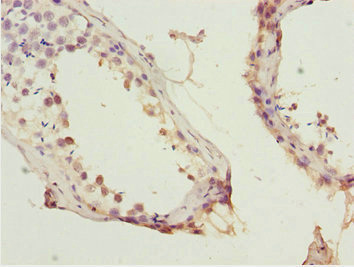
The antibody against KPNA5 was raised in rabbit using the Recombinant Human Importin subunit alpha-6 protein (1-240AA) as the immunogen. This antibody exists as a non-conjugated isotype IgG, Antigen affinity purified. This antibody has been validated on ELISA, WB, IHC.
$299.00
| Cat.No | ADC-17142A | Clonality | Polyclonal |
|---|---|---|---|
| Host Species | Rabbit | Target Name | KPNA5 |
| Form | Liquid | Species Reactivity | Human, Mouse |
| Isotype | IgG | Storage Buffer | 50% Glycerol, PBS with 0.02% sodium azide, pH7.3. |
| Purification Method | Antigen affinity purified | Conjugate | Non-conjugated |
| Application | ELISA, IHC, WB | Storage | Upon receipt |
| Immunogen Description | Recombinant Human Importin subunit alpha-6 protein (1-240AA) | Target Species | Human |
|---|---|---|---|
| Immunogen Sequence | Complete sequences for the immunogen, target protein, and peptides are available upon request. | Uniprot ID | O15131 |
Uniprot Id
O15131
Target Species
Human
Target Name
KPNA5
Target Full Name
Importin subunit alpha-6
Target Function
Functions in nuclear protein import as an adapter protein for nuclear receptor KPNB1. Binds specifically and directly to substrates containing either a simple or bipartite NLS motif. Docking of the importin/substrate complex to the nuclear pore complex (NPC) is mediated by KPNB1 through binding to nucleoporin FxFG repeats and the complex is subsequently translocated through the pore by an energy requiring, Ran-dependent mechanism. At the nucleoplasmic side of the NPC, Ran binds to importin-beta and the three components separate and importin-alpha and -beta are re-exported from the nucleus to the cytoplasm where GTP hydrolysis releases Ran from importin. The directionality of nuclear import is thought to be conferred by an asymmetric distribution of the GTP- and GDP-bound forms of Ran between the cytoplasm and nucleus. Mediates nuclear import of STAT1 homodimers and STAT1/STAT2 heterodimers by recognizing non-classical NLSs of STAT1 and STAT2 through ARM repeats 8-9. Recognizes influenza A virus nucleoprotein through ARM repeat 7-9 In vitro, mediates the nuclear import of human cytomegalovirus UL84 by recognizing a non-classical NLS.
Target Subcellular Location
Cytoplasm.
Target Protein Families
Importin alpha family
Target Tissue Specificity
Testis.
Target Synonyms
IMA5_HUMAN; Importin alpha 6; Importin subunit alpha 6; Importin subunit alpha-6; IPOA 6; IPOA6; Karyopherin alpha 5; Karyopherin alpha 5 importin alpha 6; Karyopherin subunit alpha 5; Karyopherin subunit alpha-5; KPNA 5; KPNA5; SRP 6; SRP6
Target Background
The transport of molecules between the nucleus and the cytoplasm in eukaryotic cells is mediated by the nuclear pore complex (NPC) which consists of 60-100 proteins and is probably 120 million daltons in molecular size. Small molecules (up to 70 kD) can pass through the nuclear pore by nonselective diffusion; larger molecules are transported by an active process. Most nuclear proteins contain short basic amino acid sequences known as nuclear localization signals (NLSs). KPNA5 protein belongs to the importin alpha protein family and is thought to be involved in NLS-dependent protein import into the nucleus.
Notification