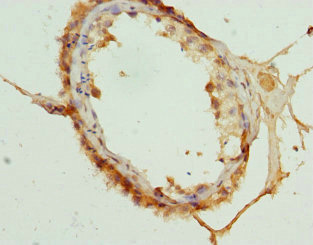
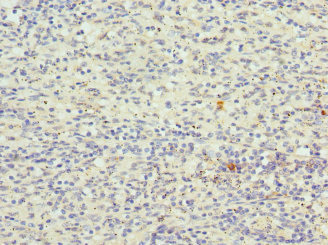
-
Chinese (Simplified)
-
English
-
German
-
Korean
-
Spanish
Chinese (Simplified)
English
German
Korean
Spanish
Sign up for an account to enjoy easy online shopping and instant order tracking.
The antibody against CDKN2D was raised in rabbit using the Recombinant Human Cyclin-dependent kinase 4 inhibitor D protein (1-166AA) as the immunogen. This antibody exists as a non-conjugated isotype IgG, Antigen affinity purified. This antibody has been validated on ELISA, IHC.
$299.00
| Cat.No | ADC-17422A | Clonality | Polyclonal |
|---|---|---|---|
| Host Species | Rabbit | Target Name | CDKN2D |
| Target Synonyms | CDKN2DCyclin-dependent kinase 4 inhibitor D antibody; p19-INK4d antibody | Form | Liquid |
| Species Reactivity | Human | Isotype | IgG |
| Storage Buffer | 50% Glycerol, PBS with 0.02% sodium azide, pH7.3. | Purification Method | Antigen affinity purified |
| Conjugate | Non-conjugated | Application | ELISA, IHC |
| Storage | Upon receipt |
| Immunogen Description | Recombinant Human Cyclin-dependent kinase 4 inhibitor D protein (1-166AA) | Target Species | Human |
|---|---|---|---|
| Immunogen Sequence | Complete sequences for the immunogen, target protein, and peptides are available upon request. | Uniprot ID | P55273 |
Uniprot Id
P55273
Target Species
Human
Target Name
CDKN2D
Target Full Name
Cyclin-dependent kinase 4 inhibitor D
Target Function
Interacts strongly with CDK4 and CDK6 and inhibits them.
Target Subcellular Location
Nucleus. Cytoplasm.
Target Protein Families
CDKN2 cyclin-dependent kinase inhibitor family
Target Research Area
Cell Biology
Target Synonyms
CDKN2DCyclin-dependent kinase 4 inhibitor D; p19-INK4d
Target Background
The protein encoded by this gene is a member of the INK4 family of cyclin-dependent kinase inhibitors. This protein has been shown to form a stable complex with CDK4 or CDK6, and prevent the activation of the CDK kinases, thus function as a cell growth regulator that controls cell cycle G1 progression. The abundance of the transcript of this gene was found to oscillate in a cell-cycle dependent manner with the lowest expression at mid G1 and a maximal expression during S phase. The negative regulation of the cell cycle involved in this protein was shown to participate in repressing neuronal proliferation, as well as spermatogenesis. Two alternatively spliced variants of this gene, which encode an identical protein, have been reported.
Notification