-
Chinese (Simplified)
-
English
-
German
-
Korean
-
Spanish

Chinese (Simplified)
English
German
Korean
Spanish
Sign up for an account to enjoy easy online shopping and instant order tracking.
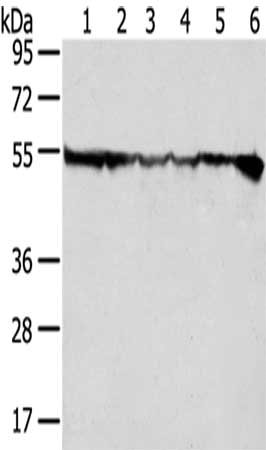
The antibody against DDX39B was raised in rabbit using the Synthetic peptide of Human DDX39B as the immunogen. This antibody exists as a non-conjugated isotype IgG, Antigen affinity purified. This antibody has been validated on ELISA, WB, IHC.
$299.00
| Cat.No | ADC-25580A | Clonality | Polyclonal |
|---|---|---|---|
| Host Species | Rabbit | Target Name | DDX39B |
| Target Synonyms | 0610030D10Rik antibody; 4F2-LC6 antibody; 56 kDa U2AF65-associated protein antibody; AI428441 antibody; ATP-dependent RNA helicase p47 antibody; B(0 | Form | Liquid |
| Species Reactivity | Human, Mouse, Rat | Isotype | IgG |
| Storage Buffer | 0.05% NaN3, 40% Glycerol., pH7.4 PBS | Purification Method | Antigen affinity purified |
| Conjugate | Non-conjugated | Application | ELISA, IHC, WB |
| Storage | Upon receipt |
| Immunogen Description | Synthetic peptide of Human DDX39B | Target Species | Human |
|---|---|---|---|
| Immunogen Sequence | Complete sequences for the immunogen, target protein, and peptides are available upon request. | Uniprot ID | Q13838 |
Uniprot Id
Q13838
Target Species
Human
Target Name
DDX39B
Target Full Name
Spliceosome RNA helicase DDX39B
Target Function
Involved in nuclear export of spliced and unspliced mRNA. Assembling component of the TREX complex which is thought to couple mRNA transcription, processing and nuclear export, and specifically associates with spliced mRNA and not with unspliced pre-mRNA. TREX is recruited to spliced mRNAs by a transcription-independent mechanism, binds to mRNA upstream of the exon-junction complex (EJC) and is recruited in a splicing- and cap-dependent manner to a region near the 5' end of the mRNA where it functions in mRNA export to the cytoplasm via the TAP/NFX1 pathway. May undergo several rounds of ATP hydrolysis during assembly of TREX to drive subsequent loading of components such as ALYREF/THOC and CHTOP onto mRNA. Also associates with pre-mRNA independent of ALYREF/THOC4 and the THO complex. Involved in the nuclear export of intronless mRNA; the ATP-bound form is proposed to recruit export adapter ALYREF/THOC4 to intronless mRNA; its ATPase activity is cooperatively stimulated by RNA and ALYREF/THOC4 and ATP hydrolysis is thought to trigger the dissociation from RNA to allow the association of ALYREF/THOC4 and the NXF1-NXT1 heterodimer. Involved in transcription elongation and genome stability.; Splice factor that is required for the first ATP-dependent step in spliceosome assembly and for the interaction of U2 snRNP with the branchpoint. Has both RNA-stimulated ATP binding/hydrolysis activity and ATP-dependent RNA unwinding activity. Even with the stimulation of RNA, the ATPase activity is weak. Can only hydrolyze ATP but not other NTPs. The RNA stimulation of ATPase activity does not have a strong preference for the sequence and length of the RNA. However, ssRNA stimulates the ATPase activity much more strongly than dsRNA. Can unwind 5' or 3' overhangs or blunt end RNA duplexes in vitro. The ATPase and helicase activities are not influenced by U2AF2; the effect of ALYREF/THOC4 is reported conflictingly with [PubMed:23299939] reporting a stimulatory effect.; (Microbial infection) The TREX complex is essential for the export of Kaposi's sarcoma-associated herpesvirus (KSHV) intronless mRNAs and infectious virus production.
Target Subcellular Location
Nucleus. Nucleus speckle. Cytoplasm. Note=Can translocate to the cytoplasm in the presence of MX1. TREX complex assembly seems to occur in regions surrounding nuclear speckles known as perispeckles.
Target Protein Families
DEAD box helicase family, DECD subfamily
Target Research Area
Epigenetics and Nuclear Signaling
Target Synonyms
0610030D10Rik; 4F2-LC6; 56 kDa U2AF65-associated protein; AI428441; ATP-dependent RNA helicase p47; B(0,+)-type amino acid transporter 1; BAT1; Bat1a; D17H6S81E; D17H6S81E-1; D6S81E; D6S81Eh; DDX39B; DEAD (Asp-Glu-Ala-Asp) box polypeptide 39B; DEAD box protein UAP56; DX39B_HUMAN; EC 3.6.1.-; Glycoprotein-associated amino acid transporter b0,+AT1; HLA-B-associated transcript 1 protein; HLA-B-associated transcript 1A; HLA-B-associated transcript-1; MGC127051; MGC19235; MGC38799; nuclear RNA helicase (DEAD family); OTTHUMP00000029229; OTTHUMP00000165889; OTTHUMP00000165890; p47; Solute carrier family 7 member 9; Spliceosome RNA helicase BAT1; Spliceosome RNA helicase DDX39B; U2AF65-associayed protein; 56-KD; UAP56
Target Background
This gene encodes a member of the DEAD box family of RNA-dependent ATPases that mediate ATP hydrolysis during pre-mRNA splicing. The encoded protein is an essential splicing factor required for association of U2 small nuclear ribonucleoprotein with pre-mRNA, and it also plays an important role in mRNA export from the nucleus to the cytoplasm. This gene belongs to a cluster of genes localized in the vicinity of the genes encoding tumor necrosis factor alpha and tumor necrosis factor beta. These genes are all within the human major histocompatibility complex class III region. Mutations in this gene may be associated with rheumatoid arthritis. Alternative splicing results in multiple transcript variants. Related pseudogenes have been identified on both chromosomes 6 and 11. Read-through transcription also occurs between this gene and the upstream ATP6V1G2 (ATPase, H+ transporting, lysosomal 13kDa, V1 subunit G2) gene.
Notification