-
Chinese (Simplified)
-
English
-
German
-
Korean
-
Spanish
Chinese (Simplified)
English
German
Korean
Spanish
Sign up for an account to enjoy easy online shopping and instant order tracking.
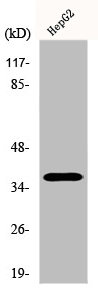
The antibody against EFNA3 was raised in rabbit using the Synthesized peptide derived from the C-terminal region of Human Ephrin-A3. as the immunogen. This antibody exists as a non-conjugated isotype IgG. The antibody was affinity-purified from rabbit antiserum by affinity-chromatography using epitope-specific immunogen. This antibody has been validated on WB, IHC, IF, ELISA.
$167.00
| Cat.No | ADC-38733A | Clonality | Polyclonal |
|---|---|---|---|
| Host Species | Rabbit | Target Name | EFNA3 |
| Form | Liquid | Species Reactivity | Human, Mouse, Rat |
| Isotype | IgG | Storage Buffer | 0.5% BSA and 0.02% sodium azide., Liquid in PBS containing 50% glycerol |
| Purification Method | The antibody was affinity-purified from rabbit antiserum by affinity-chromatography using epitope-specific immunogen. | Conjugate | Non-conjugated |
| Application | ELISA, IF, IHC, WB | Storage | Upon receipt |
| Immunogen Description | Synthesized peptide derived from the C-terminal region of Human Ephrin-A3. | Target Species | Human |
|---|---|---|---|
| Immunogen Sequence | Complete sequences for the immunogen, target protein, and peptides are available upon request. | Uniprot ID | P52797 |
Uniprot Id
P52797
Target Species
Human
Target Name
EFNA3
Target Full Name
Ephrin-A3
Target Function
Cell surface GPI-bound ligand for Eph receptors, a family of receptor tyrosine kinases which are crucial for migration, repulsion and adhesion during neuronal, vascular and epithelial development. Binds promiscuously Eph receptors residing on adjacent cells, leading to contact-dependent bidirectional signaling into neighboring cells. The signaling pathway downstream of the receptor is referred to as forward signaling while the signaling pathway downstream of the ephrin ligand is referred to as reverse signaling.
Target Subcellular Location
Cell membrane; Lipid-anchor, GPI-anchor.
Target Protein Families
Ephrin family
Target Tissue Specificity
Expressed in brain, skeletal muscle, spleen, thymus, prostate, testis, ovary, small intestine, and peripheral blood leukocytes.
Target Synonyms
EFL 2; EFL-2; EFL2; EFN A3; EFNA 3; Efna3; EFNA3_HUMAN; EHK1 L; EHK1 ligand; EHK1-L; EHK1L; EPH related receptor tyrosine kinase ligand 3; EPH-related receptor tyrosine kinase ligand 3; Ephrin-A3; EphrinA3; EPLG 3; EPLG3; LERK 3; LERK-3; LERK3; Ligand of eph related kinase 3
Target Background
This gene encodes a member of the ephrin (EPH) family. The ephrins and EPH-related receptors comprise the largest subfamily of receptor protein-tyrosine kinases and have been implicated in mediating developmental events, especially in the nervous system and in erythropoiesis. Based on their structures and sequence relationships, ephrins are divided into the ephrin-A (EFNA) class, which are anchored to the membrane by a glycosylphosphatidylinositol linkage, and the ephrin-B (EFNB) class, which are transmembrane proteins. This gene encodes an EFNA class ephrin.
Notification