-
Chinese (Simplified)
-
English
-
German
-
Korean
-
Spanish
Chinese (Simplified)
English
German
Korean
Spanish
Sign up for an account to enjoy easy online shopping and instant order tracking.
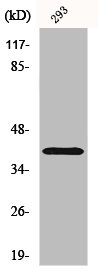
The antibody against ATP1B3 was raised in rabbit using the Synthesized peptide derived from the Internal region of Human CD298. as the immunogen. This antibody exists as a non-conjugated isotype IgG. The antibody was affinity-purified from rabbit antiserum by affinity-chromatography using epitope-specific immunogen. This antibody has been validated on WB, ELISA.
$167.00
| Cat.No | ADC-39092A | Clonality | Polyclonal |
|---|---|---|---|
| Host Species | Rabbit | Target Name | ATP1B3 |
| Target Synonyms | ATP1B3; Sodium/potassium-transporting ATPase subunit beta-3; Sodium/potassium-dependent ATPase subunit beta-3; ATPB-3; CD antigen CD298 | Form | Liquid |
| Species Reactivity | Human | Isotype | IgG |
| Storage Buffer | 0.5% BSA and 0.02% sodium azide., Liquid in PBS containing 50% glycerol | Purification Method | The antibody was affinity-purified from rabbit antiserum by affinity-chromatography using epitope-specific immunogen. |
| Conjugate | Non-conjugated | Application | ELISA, WB |
| Storage | Upon receipt |
| Immunogen Description | Synthesized peptide derived from the Internal region of Human CD298. | Target Species | Human |
|---|---|---|---|
| Immunogen Sequence | Complete sequences for the immunogen, target protein, and peptides are available upon request. | Uniprot ID | P54709 |
Uniprot Id
P54709
Target Species
Human
Target Name
ATP1B3
Target Full Name
Sodium/potassium-transporting ATPase subunit beta-3
Target Function
This is the non-catalytic component of the active enzyme, which catalyzes the hydrolysis of ATP coupled with the exchange of Na(+) and K(+) ions across the plasma membrane. The exact function of the beta-3 subunit is not known.
Target Subcellular Location
Apical cell membrane; Single-pass type II membrane protein. Basolateral cell membrane; Single-pass type II membrane protein. Melanosome. Note=Identified by mass spectrometry in melanosome fractions from stage I to stage IV.
Target Protein Families
X(+)/potassium ATPases subunit beta family
Target Synonyms
ATP1B3; Sodium/potassium-transporting ATPase subunit beta-3; Sodium/potassium-dependent ATPase subunit beta-3; ATPB-3; CD antigen CD298
Target Background
The protein encoded by this gene belongs to the family of Na+/K+ and H+/K+ ATPases beta chain proteins, and to the subfamily of Na+/K+ -ATPases. Na+/K+ -ATPase is an integral membrane protein responsible for establishing and maintaining the electrochemical gradients of Na and K ions across the plasma membrane. These gradients are essential for osmoregulation, for sodium-coupled transport of a variety of organic and inorganic molecules, and for electrical excitability of nerve and muscle. This enzyme is composed of two subunits, a large catalytic subunit (alpha) and a smaller glycoprotein subunit (beta). The beta subunit regulates, through assembly of alpha/beta heterodimers, the number of sodium pumps transported to the plasma membrane. The glycoprotein subunit of Na+/K+ -ATPase is encoded by multiple genes. This gene encodes a beta 3 subunit. This gene encodes a beta 3 subunit. A pseudogene exists for this gene, and it is located on chromosome 2.
Notification