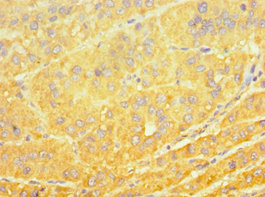
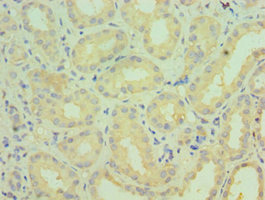
-
Chinese (Simplified)
-
English
-
German
-
Korean
-
Spanish

Chinese (Simplified)
English
German
Korean
Spanish
Sign up for an account to enjoy easy online shopping and instant order tracking.
The antibody against CYP4A11 was raised in rabbit using the Recombinant Human Cytochrome P450 4A11 protein (1-200AA) as the immunogen. This antibody exists as a non-conjugated isotype IgG, Antigen affinity purified. This antibody has been validated on ELISA, IHC.
$299.00
| Cat.No | ADC-40402A | Clonality | Polyclonal |
|---|---|---|---|
| Host Species | Rabbit | Target Name | CYP4A11 |
| Form | Liquid | Species Reactivity | Human |
| Isotype | IgG | Storage Buffer | 50% Glycerol, PBS with 0.02% sodium azide, pH7.3. |
| Purification Method | Antigen affinity purified | Conjugate | Non-conjugated |
| Application | ELISA, IHC | Storage | Upon receipt |
| Immunogen Description | Recombinant Human Cytochrome P450 4A11 protein (1-200AA) | Target Species | Human |
|---|---|---|---|
| Immunogen Sequence | Complete sequences for the immunogen, target protein, and peptides are available upon request. | Uniprot ID | Q02928 |
Uniprot Id
Q02928
Target Species
Human
Target Name
CYP4A11
Target Full Name
Cytochrome P450 4A11
Target Function
A cytochrome P450 monooxygenase involved in the metabolism of fatty acids and their oxygenated derivatives (oxylipins). Mechanistically, uses molecular oxygen inserting one oxygen atom into a substrate, and reducing the second into a water molecule, with two electrons provided by NADPH via cytochrome P450 reductase (CPR; NADPH-ferrihemoprotein reductase). Catalyzes predominantly the oxidation of the terminal carbon (omega-oxidation) of saturated and unsaturated fatty acids, the catalytic efficiency decreasing in the following order: dodecanoic > tetradecanoic > (9Z)-octadecenoic > (9Z,12Z)-octadecadienoic > hexadecanoic acid. Acts as a major omega-hydroxylase for dodecanoic (lauric) acid in liver. Participates in omega-hydroxylation of (5Z,8Z,11Z,14Z)-eicosatetraenoic acid (arachidonate) to 20-hydroxyeicosatetraenoic acid (20-HETE), a signaling molecule acting both as vasoconstrictive and natriuretic with overall effect on arterial blood pressure. Can also catalyze the oxidation of the penultimate carbon (omega-1 oxidation) of fatty acids with lower efficiency. May contribute to the degradation of saturated very long-chain fatty acids (VLCFAs) such as docosanoic acid, by catalyzing successive omega-oxidations to the corresponding dicarboxylic acid, thereby initiating chain shortening. Omega-hydroxylates (9R,10S)-epoxy-octadecanoate stereoisomer. Plays a minor role in omega-oxidation of long-chain 3-hydroxy fatty acids. Has little activity toward prostaglandins A1 and E1.
Target Subcellular Location
Endoplasmic reticulum membrane; Peripheral membrane protein. Microsome membrane; Peripheral membrane protein.
Target Protein Families
Cytochrome P450 family
Target Tissue Specificity
Expressed in liver. Expressed in S2 and S3 segments of proximal tubules in cortex and outer medulla of kidney.
Target Synonyms
CP4Y; CYP4A2; CYP4AII; CYPIVA11; Cytochrome P450 4A (CYP4A11)
Target Background
This gene encodes a member of the cytochrome P450 superfamily of enzymes. The cytochrome P450 proteins are monooxygenases which catalyze many reactions involved in drug metabolism and synthesis of cholesterol, steroids and other lipids. This protein localizes to the endoplasmic reticulum and hydroxylates medium-chain fatty acids such as laurate and myristate. Multiple transcript variants have been found for this gene.
Notification