-
Chinese (Simplified)
-
English
-
German
-
Korean
-
Spanish
Chinese (Simplified)
English
German
Korean
Spanish
Sign up for an account to enjoy easy online shopping and instant order tracking.
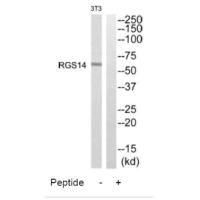
The antibody against RGS14 was raised in rabbit using the Synthesized peptide derived from internal of Human RGS14. as the immunogen. The antibody was affinity-purified from rabbit antiserum by affinity-chromatography using epitope-specific immunogen. This antibody has been validated on ELISA, WB.
$297.00
| Cat.No | ADC-40965A | Clonality | Polyclonal |
|---|---|---|---|
| Host Species | Rabbit | Target Name | RGS14 |
| Form | Liquid | Species Reactivity | Human |
| Storage Buffer | PH 7.4, 0.02% sodium azide and 50% glycerol., 150mM NaCl, Rabbit IgG in phosphate buffered saline (without Mg2+ and Ca2+) | Purification Method | The antibody was affinity-purified from rabbit antiserum by affinity-chromatography using epitope-specific immunogen. |
| Application | ELISA, WB | Storage | Upon receipt |
| Immunogen Description | Synthesized peptide derived from internal of Human RGS14. | Target Species | Human |
|---|---|---|---|
| Immunogen Sequence | Complete sequences for the immunogen, target protein, and peptides are available upon request. | Uniprot ID | O43566 |
Uniprot Id
O43566
Target Species
Human
Target Name
RGS14
Target Full Name
Regulator of G-protein signaling 14
Target Function
Regulates G protein-coupled receptor signaling cascades. Inhibits signal transduction by increasing the GTPase activity of G protein alpha subunits, thereby driving them into their inactive GDP-bound form. Besides, modulates signal transduction via G protein alpha subunits by functioning as a GDP-dissociation inhibitor (GDI). Has GDI activity on G(i) alpha subunits GNAI1 and GNAI3, but not on GNAI2 and G(o) alpha subunit GNAO1. Has GAP activity on GNAI0, GNAI2 and GNAI3. May act as a scaffold integrating G protein and Ras/Raf MAPkinase signaling pathways. Inhibits platelet-derived growth factor (PDGF)-stimulated ERK1/ERK2 phosphorylation; a process depending on its interaction with HRAS and that is reversed by G(i) alpha subunit GNAI1. Acts as a positive modulator of microtubule polymerisation and spindle organization through a G(i)-alpha-dependent mechanism. Plays a role in cell division. Required for the nerve growth factor (NGF)-mediated neurite outgrowth. Involved in stress resistance. May be involved in visual memory processing capacity and hippocampal-based learning and memory.
Target Subcellular Location
Nucleus. Nucleus, PML body. Cytoplasm. Membrane. Cell membrane. Cytoplasm, cytoskeleton, microtubule organizing center, centrosome. Cytoplasm, cytoskeleton, spindle. Cytoplasm, cytoskeleton, spindle pole. Cell projection, dendrite. Cell projection, dendritic spine. Cell junction, synapse, postsynaptic density.
Target Synonyms
Highly similar to rap1/rap2 interacting protein; OTTHUMP00000223586; OTTHUMP00000223587; Regulation of G protein signaling 14; Regulator of G protein signaling 14; Regulator of G protein signalling 14; Regulator of G-protein signaling 14; RGS 14; RGS14; RGS14_HUMAN
Target Background
This gene encodes a member of the regulator of G-protein signaling family. This protein contains one RGS domain, two Raf-like Ras-binding domains (RBDs), and one GoLoco domain. The protein attenuates the signaling activity of G-proteins by binding, through its GoLoco domain, to specific types of activated, GTP-bound G alpha subunits. Acting as a GTPase activating protein (GAP), the protein increases the rate of conversion of the GTP to GDP. This hydrolysis allows the G alpha subunits to bind G beta/gamma subunit heterodimers, forming inactive G-protein heterotrimers, thereby terminating the signal. Alternate transcriptional splice variants of this gene have been observed but have not been thoroughly characterized.
Notification