-
Chinese (Simplified)
-
English
-
German
-
Korean
-
Spanish
Chinese (Simplified)
English
German
Korean
Spanish
Sign up for an account to enjoy easy online shopping and instant order tracking.
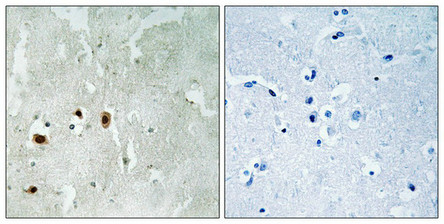
The antibody against KAT5 was raised in rabbit using the Peptide sequence around phosphorylation site of Serine 90(P-G-S(p)-P-E) derived from Human Tip60. as the immunogen. Antibodies were produced by immunizing rabbits with synthetic phosphopeptide and KLH conjugates. Antibodies were purified by affinity-chromatography using epitope-specific phosphopeptide. Non-phospho specific antibodies were removed by chromatogramphy usi This antibody has been validated on ELISA, IHC.
$360.00
| Cat.No | ADC-42672A | Clonality | Polyclonal |
|---|---|---|---|
| Host Species | Rabbit | Target Name | KAT5 |
| Target Synonyms | 60kDa antibody; TIP antibody; Tip60 antibody | Form | Liquid |
| Species Reactivity | Human, Mouse, Rat | Storage Buffer | PH 7.4, 0.02% sodium azide and 50% glycerol., 150mM NaCl, Rabbit IgG in phosphate buffered saline (without Mg2+ and Ca2+) |
| Application | ELISA, IHC | Storage | Upon receipt |
| Immunogen Description | Peptide sequence around phosphorylation site of Serine 90(P-G-S(p)-P-E) derived from Human Tip60. | Target Species | Human |
|---|---|---|---|
| Immunogen Sequence | Complete sequences for the immunogen, target protein, and peptides are available upon request. | Uniprot ID | Q92993 |
Uniprot Id
Q92993
Target Species
Human
Target Name
KAT5
Target Full Name
Histone acetyltransferase KAT5
Target Function
Catalytic subunit of the NuA4 histone acetyltransferase complex which is involved in transcriptional activation of select genes principally by acetylation of nucleosomal histones H4 and H2A. This modification may both alter nucleosome-DNA interactions and promote interaction of the modified histones with other proteins which positively regulate transcription. This complex may be required for the activation of transcriptional programs associated with oncogene and proto-oncogene mediated growth induction, tumor suppressor mediated growth arrest and replicative senescence, apoptosis, and DNA repair. NuA4 may also play a direct role in DNA repair when recruited to sites of DNA damage. Component of a SWR1-like complex that specifically mediates the removal of histone H2A.Z/H2AZ1 from the nucleosome. Also acetylates non-histone proteins, such as ATM, NR1D2, RAN, FOXP3, ULK1 and RUBCNL/Pacer. Directly acetylates and activates ATM. Relieves NR1D2-mediated inhibition of APOC3 expression by acetylating NR1D2. Promotes FOXP3 acetylation and positively regulates its transcriptional repressor activity. Acetylates RAN at 'Lys-134'. Together with GSK3 (GSK3A or GSK3B), acts as a regulator of autophagy: phosphorylated at Ser-86 by GSK3 under starvation conditions, leading to activate acetyltransferase activity and promote acetylation of key autophagy regulators, such as ULK1 and RUBCNL/Pacer.
Target Subcellular Location
Nucleus. Nucleus, nucleolus. Cytoplasm, perinuclear region. Note=Upon stimulation with EDN1, it is exported from the nucleus to the perinuclear region and UV irradiation induces translocation into punctuate subnuclear structures named nuclear bodies.
Target Protein Families
MYST (SAS/MOZ) family
Target Research Area
Immunology
Target Synonyms
60 kDa Tat interactive protein; 60 kDa Tat-interactive protein; cPLA(2) interacting protein; cPLA(2)-interacting protein; cPLA2; cPLA2 interacting protein; ESA1; Histone acetyltransferase HTATIP; Histone acetyltransferase KAT5; HIV 1 Tat interactive protein; HIV 1 Tat interactive protein, 60kDa; HIV-1 Tat interactive protein; HTATIP; HTATIP1; K(lysine) acetyltransferase 5; K-acetyltransferase 5; KAT5; KAT5_HUMAN; Lysine acetyltransferase 5; PLIP; Tat interacting protein, 60kDa; TIP; Tip60
Target Background
Predicted to enable PDZ domain binding activity; integrin binding activity; and protein homodimerization activity. Involved in intestinal absorption; regulation of cytokine production; and regulation of membrane permeability. Acts upstream of or within cell adhesion and epithelial cell differentiation. Located in bicellular tight junction. Is expressed in several structures, including 4-8 cell stage embryo; alimentary system; respiratory system; sensory organ; and urinary system. Human ortholog(s) of this gene implicated in hypertension. Orthologous to human F11R (F11 receptor).
Notification