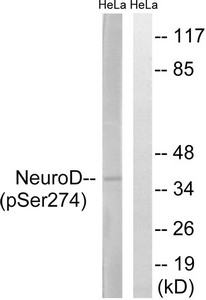
-
Chinese (Simplified)
-
English
-
German
-
Korean
-
Spanish
Chinese (Simplified)
English
German
Korean
Spanish
Sign up for an account to enjoy easy online shopping and instant order tracking.
The antibody against NEUROD1 was raised in rabbit using the Peptide sequence around phosphorylation site of Serine 274(P-L-S(p)-P-P) derived from Human Neuro D. as the immunogen. Antibodies were produced by immunizing rabbits with synthetic phosphopeptide and KLH conjugates. Antibodies were purified by affinity-chromatography using epitope-specific phosphopeptide. Non-phospho specific antibodies were removed by chromatogramphy usi This antibody has been validated on ELISA, WB.
$360.00
| Cat.No | ADC-42678A | Clonality | Polyclonal |
|---|---|---|---|
| Host Species | Rabbit | Target Name | NEUROD1 |
| Form | Liquid | Species Reactivity | Human, Mouse, Rat |
| Storage Buffer | PH 7.4, 0.02% sodium azide and 50% glycerol., 150mM NaCl, Rabbit IgG in phosphate buffered saline (without Mg2+ and Ca2+) | Application | ELISA, WB |
| Storage | Upon receipt |
| Immunogen Description | Peptide sequence around phosphorylation site of Serine 274(P-L-S(p)-P-P) derived from Human Neuro D. | Target Species | Human |
|---|---|---|---|
| Immunogen Sequence | Complete sequences for the immunogen, target protein, and peptides are available upon request. | Uniprot ID | Q13562 |
Uniprot Id
Q13562
Target Species
Human
Target Name
NEUROD1
Target Full Name
Neurogenic differentiation factor 1
Target Function
Acts as a transcriptional activator: mediates transcriptional activation by binding to E box-containing promoter consensus core sequences 5'-CANNTG-3'. Associates with the p300/CBP transcription coactivator complex to stimulate transcription of the secretin gene as well as the gene encoding the cyclin-dependent kinase inhibitor CDKN1A. Contributes to the regulation of several cell differentiation pathways, like those that promote the formation of early retinal ganglion cells, inner ear sensory neurons, granule cells forming either the cerebellum or the dentate gyrus cell layer of the hippocampus, endocrine islet cells of the pancreas and enteroendocrine cells of the small intestine. Together with PAX6 or SIX3, is required for the regulation of amacrine cell fate specification. Also required for dendrite morphogenesis and maintenance in the cerebellar cortex. Associates with chromatin to enhancer regulatory elements in genes encoding key transcriptional regulators of neurogenesis.
Target Involvement
Maturity-onset diabetes of the young 6 (MODY6); Diabetes mellitus, non-insulin-dependent (NIDDM)
Target Subcellular Location
Cytoplasm. Nucleus.
Target Synonyms
atonal; basic helix loop helix transcription factor; BETA 2; Beta cell E box transactivator 2; BETA2; BHF 1; BHF1; bHLHa3; class A basic helix loop helix protein 3; Class A basic helix-loop-helix protein 3; MODY 6; MODY6; NDF1_HUMAN; NeuroD; NeuroD1; Neurogenic differentiation 1; Neurogenic differentiation factor 1; neurogenic helix loop helix protein NEUROD; Neuronal differentiation 1
Target Background
This gene encodes a member of the NeuroD family of basic helix-loop-helix (bHLH) transcription factors. The protein forms heterodimers with other bHLH proteins and activates transcription of genes that contain a specific DNA sequence known as the E-box. It regulates expression of the insulin gene, and mutations in this gene result in type II diabetes mellitus.
Notification