-
Chinese (Simplified)
-
English
-
German
-
Korean
-
Spanish
Chinese (Simplified)
English
German
Korean
Spanish
Sign up for an account to enjoy easy online shopping and instant order tracking.
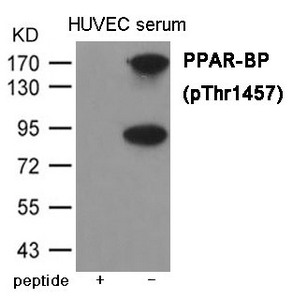
The antibody against MED1 was raised in rabbit using the Peptide sequence around phosphorylation site of Threonine 1457(A-Y-T(p)-P-Q) derived from Human PPAR-BP. as the immunogen. Antibodies were produced by immunizing rabbits with synthetic phosphopeptide and KLH conjugates. Antibodies were purified by affinity-chromatography using epitope-specific phosphopeptide. Non-phospho specific antibodies were removed by chromatogramphy usi This antibody has been validated on ELISA, WB.
$360.00
| Cat.No | ADC-42998A | Clonality | Polyclonal |
|---|---|---|---|
| Host Species | Rabbit | Target Name | MED1 |
| Form | Liquid | Species Reactivity | Human, Mouse |
| Storage Buffer | PH 7.4, 0.02% sodium azide and 50% glycerol., 150mM NaCl, Supplied at 1.0mg/mL in phosphate buffered saline (without Mg2+ and Ca2+) | Application | ELISA, WB |
| Storage | Upon receipt |
| Immunogen Description | Peptide sequence around phosphorylation site of Threonine 1457(A-Y-T(p)-P-Q) derived from Human PPAR-BP. | Target Species | Human |
|---|---|---|---|
| Immunogen Sequence | Complete sequences for the immunogen, target protein, and peptides are available upon request. | Uniprot ID | Q15648 |
Uniprot Id
Q15648
Target Species
Human
Target Name
MED1
Target Full Name
Mediator of RNA polymerase II transcription subunit 1
Target Function
Component of the Mediator complex, a coactivator involved in the regulated transcription of nearly all RNA polymerase II-dependent genes. Mediator functions as a bridge to convey information from gene-specific regulatory proteins to the basal RNA polymerase II transcription machinery. Mediator is recruited to promoters by direct interactions with regulatory proteins and serves as a scaffold for the assembly of a functional preinitiation complex with RNA polymerase II and the general transcription factors. Acts as a coactivator for GATA1-mediated transcriptional activation during erythroid differentiation of K562 erythroleukemia cells.
Target Subcellular Location
Nucleus. Note=A subset of the protein may enter the nucleolus subsequent to phosphorylation by MAPK1 or MAPK3.
Target Protein Families
Mediator complex subunit 1 family
Target Tissue Specificity
Ubiquitously expressed.
Target Research Area
Epigenetics and Nuclear Signaling
Target Synonyms
Activator-recruited cofactor 205 kDa component; ARC205; CRSP1; CRSP200; DRIP205; DRIP230; MED1; MED1_HUMAN; Mediator complex subunit 1; Mediator of RNA polymerase II transcription subunit 1; p53 regulatory protein RB18A; PBP; Peroxisome proliferator-activated receptor-binding protein; PPAR binding protein ; PPAR-binding protein; PPARBP ; PPARGBP; RB18A; Thyroid hormone receptor-associated protein complex 220 kDa component; Thyroid receptor-interacting protein 2; TR-interacting protein 2; Trap220; TRIP-2; TRIP2; Vitamin D receptor-interacting protein complex component DRIP205
Target Background
The activation of gene transcription is a multistep process that is triggered by factors that recognize transcriptional enhancer sites in DNA. These factors work with co-activators to direct transcriptional initiation by the RNA polymerase II apparatus. The protein encoded by this gene is a subunit of the CRSP (cofactor required for SP1 activation) complex, which, along with TFIID, is required for efficient activation by SP1. This protein is also a component of other multisubunit complexes e.g. thyroid hormone receptor-(TR-) associated proteins which interact with TR and facilitate TR function on DNA templates in conjunction with initiation factors and cofactors. It also regulates p53-dependent apoptosis and it is essential for adipogenesis. This protein is known to have the ability to self-oligomerize.
Notification