-
Chinese (Simplified)
-
English
-
German
-
Korean
-
Spanish
Chinese (Simplified)
English
German
Korean
Spanish
Sign up for an account to enjoy easy online shopping and instant order tracking.
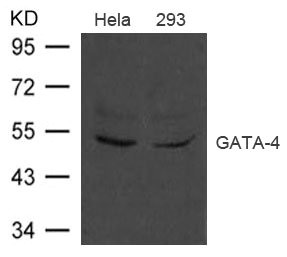
The antibody against GATA4 was raised in rabbit using the Peptide sequence around aa.434~438(D-S-H-G-D) derived from Human GATA-4. as the immunogen. Antibodies were produced by immunizing rabbits with synthetic peptide and KLH conjugates. Antibodies were purified by affinity-chromatography using epitope-specific peptide. This antibody has been validated on ELISA, WB.
$297.00
| Cat.No | ADC-43183A | Clonality | Polyclonal |
|---|---|---|---|
| Host Species | Rabbit | Target Name | GATA4 |
| Form | Liquid | Species Reactivity | Human, Mouse, Rat |
| Storage Buffer | PH 7.4, 0.02% sodium azide and 50% glycerol., 150mM NaCl, Supplied at 1.0mg/mL in phosphate buffered saline (without Mg2+ and Ca2+) | Purification Method | Antibodies were produced by immunizing rabbits with synthetic peptide and KLH conjugates. Antibodies were purified by affinity-chromatography using epitope-specific peptide. |
| Application | ELISA, WB | Storage | Upon receipt |
| Immunogen Description | Peptide sequence around aa.434~438(D-S-H-G-D) derived from Human GATA-4. | Target Species | Human |
|---|---|---|---|
| Immunogen Sequence | Complete sequences for the immunogen, target protein, and peptides are available upon request. | Uniprot ID | P43694 |
Uniprot Id
P43694
Target Species
Human
Target Name
GATA4
Target Full Name
Transcription factor GATA-4
Target Function
Transcriptional activator that binds to the consensus sequence 5'-AGATAG-3' and plays a key role in cardiac development and function. In cooperation with TBX5, it binds to cardiac super-enhancers and promotes cardiomyocyte gene expression, while it downregulates endocardial and endothelial gene expression. Involved in bone morphogenetic protein (BMP)-mediated induction of cardiac-specific gene expression. Binds to BMP response element (BMPRE) DNA sequences within cardiac activating regions. Acts as a transcriptional activator of ANF in cooperation with NKX2-5. Promotes cardiac myocyte enlargement. Required during testicular development. May play a role in sphingolipid signaling by regulating the expression of sphingosine-1-phosphate degrading enzyme, sphingosine-1-phosphate lyase.
Target Involvement
Atrial septal defect 2 (ASD2); Ventricular septal defect 1 (VSD1); Tetralogy of Fallot (TOF); Atrioventricular septal defect 4 (AVSD4); Testicular anomalies with or without congenital heart disease (TACHD)
Target Subcellular Location
Nucleus.
Target Synonyms
ASD2; GATA 4; GATA binding protein 4; GATA-binding factor 4; gata4; GATA4_HUMAN; MGC126629; Transcription factor GATA 4; Transcription factor GATA-4; Transcription factor GATA4; VSD1
Target Background
This gene encodes a member of the GATA family of zinc-finger transcription factors. Members of this family recognize the GATA motif which is present in the promoters of many genes. This protein is thought to regulate genes involved in embryogenesis and in myocardial differentiation and function, and is necessary for normal testicular development. Mutations in this gene have been associated with cardiac septal defects. Additionally, alterations in gene expression have been associated with several cancer types. Alternative splicing results in multiple transcript variants.
Notification