• Contact info@abtriva.com for inquiries and orders.
  • Chinese (Simplified)

  • English

  • German

  • Korean

  • Spanish

United States (English / $ USD)

Rabbit anti-Mouse CD81 Polyclonal Antibody

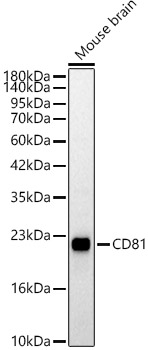
The antibody against CD81 was raised in Rabbit using the recombinant fusion protein containing a sequence corresponding to amino acids 106-211 of mouse CD81(NP_598416.1) as the immunogen. The polyclonal antibody exists as a isotype IgG, by affinity purification. This antibody has been validated on WB, ELISA.

ADA-08206A

The antibody against CD81 was raised in Rabbit using the recombinant fusion protein containing a sequence corresponding to amino acids 106-211 of mouse CD81(NP_598416.1) as the immunogen. The polyclonal antibody exists as a isotype IgG, by affinity purification. This antibody has been validated on WB, ELISA.

Number
Order Exclusive Products Now

Request a Quote
High Purity LevelsPrecision and ReliabilityCustomization Options

Specifications


Cat.No ADA-08206A ClonalityPolyclonal
Host SpeciesRabbitTarget NameCD81
Target SynonymsTapa1; Tapa-1; Tspan28; CD81FormLiquid
Species ReactivityMouse, RatIsotypeIgG
Storage Buffer50% Glycerol, PBS with 0.05% proclin300, pH7.3.Purification MethodAffinity purification
Positive SamplesRat brain, Mouse brainApplicationELISA, WB

Immunogen Information


Immunogen DescriptionRecombinant fusion protein containing a sequence corresponding to amino acids 106-211 of mouse CD81(NP_598416.1).Target SpeciesMouse
Immunogen SequenceVAAGIWGFVNKDQIAKDVKQFYDQALQQAVMDDDANNAKAVVKTFHETLNCCGSNALTTLTTTILRNSLCPSGGNILTPLLQQDCHQKIDELFSGKLYLIGIAAIVUniprot IDP35762
Background Information
  • Uniprot Id

    P35762

  • Target Species

    Mouse

  • Target Name

    CD81

  • Target Full Name

    CD81 antigen

  • Target Function

    Structural component of specialized membrane microdomains known as tetraspanin-enriched microdomains (TERMs), which act as platforms for receptor clustering and signaling. Essential for trafficking and compartmentalization of CD19 receptor on the cell surface of activated B cells. Upon initial encounter with a microbial pathogen, enables the assembly of CD19-CR2 and B cell receptor complexes at signaling TERMs, lowering the threshold dose of antigen required to trigger B cell clonal expansion and humoral immune response. In T cells, associates with CD4 or CD8 coreceptors and defines the maturation state of antigen-induced synapses with B cells. Facilitates localization of CD3 in these immune synapses, required for costimulation and sustained activation of T cells, preferentially triggering T helper type 2 immune response. Can act both as positive and negative regulator of homotypic or heterotypic cell-cell fusion processes. In myoblasts, associates with another tetraspanin CD9 in complex with PTGFRN and inhibits myotube fusion during muscle regeneration. In macrophages, associates with CD9 and beta-1 and beta-2 integrins, and prevents macrophage fusion into multinucleated giant cells specialized in ingesting complement-opsonized large particles. Also prevents the fusion between mononuclear cell progenitors into osteoclasts in charge of bone resorption. Positively regulates sperm-egg fusion and may be involved in the acrosome reaction. Regulates protein trafficking in intracellular compartments. In T cells, associates with dNTPase SAMHD1 and defines its subcellular location, enabling its degradation by the proteasome and thereby controlling intracellular dNTP levels. Also regulates integrin-dependent migration of macrophages, particularly relevant for inflammatory response in the lung.; (Microbial infection) Specifically required for Plasmodium yoelii infectivity of hepatocytes, controlling sporozoite entry in hepatocytes via the parasitophorous vacuole and subsequent parasite differentiation to exoerythrocytic forms.

  • Target Subcellular Location

    Cell membrane; Multi-pass membrane protein. Basolateral cell membrane; Multi-pass membrane protein.

  • Target Protein Families

    Tetraspanin (TM4SF) family

  • Target Tissue Specificity

    Expressed in oocytes (at protein level). Highly expressed in granulosa cells. Expressed in skeletal muscle mainly in endothelial cells of endomysial capillaries, in satellite cells and myoblasts (at protein level). Expressed in hepatocytes (at protein lev

  • Target Synonyms

    Tapa1; Tapa-1; Tspan28; CD81

  • Target Background

    Predicted to enable cholesterol binding activity; signaling receptor binding activity; and virus receptor activity. Involved in several processes, including cellular response to low-density lipoprotein particle stimulus; positive regulation of immune response; and syncytium formation by plasma membrane fusion. Acts upstream of or within regulation of cell motility. Located in membrane. Is expressed in several structures, including alimentary system; extraembryonic component; genitourinary system; nervous system; and sensory organ. Human ortholog(s) of this gene implicated in common variable immunodeficiency. Orthologous to human CD81 (CD81 molecule).

Inquire Rabbit anti-Mouse CD81 Polyclonal Antibody Now


AbTriva respects your privacy and protects your personal data in accordance with AbTriva. For more information, please see our data protection statement. *

Notification