• Contact info@abtriva.com for inquiries and orders.
  • Chinese (Simplified)

  • English

  • German

  • Korean

  • Spanish

United States (English / $ USD)

Rabbit anti-Human MYH9 Polyclonal Antibody

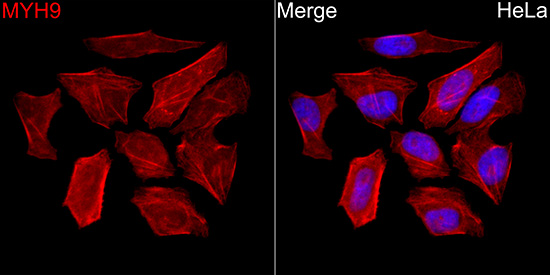
The antibody against MYH9 was raised in Rabbit using the recombinant Protein corresponding to a sequence within amino acids 1860-1960 of human MYH9(NP_002464.1) as the immunogen. The polyclonal antibody exists as a isotype IgG, by affinity purification. This antibody has been validated on IF/ICC, ELISA.

ADA-08400A

The antibody against MYH9 was raised in Rabbit using the recombinant Protein corresponding to a sequence within amino acids 1860-1960 of human MYH9(NP_002464.1) as the immunogen. The polyclonal antibody exists as a isotype IgG, by affinity purification. This antibody has been validated on IF/ICC, ELISA.

Number
Order Exclusive Products Now

Request a Quote
High Purity LevelsPrecision and ReliabilityCustomization Options

Specifications


Cat.No ADA-08400A ClonalityPolyclonal
Host SpeciesRabbitTarget NameMYH9
Target SynonymsMHA; FTNS; EPSTS; BDPLT6; DFNA17; MATINS; NMMHCA; NMHC-II-A; NMMHC-IIA; MYH9FormLiquid
Species ReactivityHuman, MouseIsotypeIgG
Storage Buffer50% Glycerol, PBS with 0.05% proclin300, pH7.3.Purification MethodAffinity purification
ApplicationELISA, IF/ICC

Immunogen Information


Immunogen DescriptionRecombinant Protein corresponding to a sequence within amino acids 1860-1960 of human MYH9(NP_002464.1).Target SpeciesHuman
Immunogen SequenceQYKDQADKASTRLKQLKRQLEEAEEEAQRANASRRKLQRELEDATETADAMNREVSSLKNKLRRGDLPFVVPRRMARKGAGDGSDEEVDGKADGAEAKPAEUniprot IDP35579
Background Information
  • Uniprot Id

    P35579

  • Target Species

    Human

  • Target Name

    MYH9

  • Target Full Name

    Myosin-9

  • Target Function

    Cellular myosin that appears to play a role in cytokinesis, cell shape, and specialized functions such as secretion and capping. Required for cortical actin clearance prior to oocyte exocytosis. Promotes cell motility in conjunction with S100A4. During cell spreading, plays an important role in cytoskeleton reorganization, focal contact formation (in the margins but not the central part of spreading cells), and lamellipodial retraction; this function is mechanically antagonized by MYH10.

  • Target Involvement

    May-Hegglin anomaly (MHA); Sebastian syndrome (SBS); Fechtner syndrome (FTNS); Epstein syndrome (EPSTNS); Deafness, autosomal dominant, 17 (DFNA17); Macrothrombocytopenia and progressive sensorineural deafness (MPSD)

  • Target Subcellular Location

    Cytoplasm, cytoskeleton. Cytoplasm, cell cortex. Cytoplasmic vesicle, secretory vesicle, Cortical granule.

  • Target Protein Families

    TRAFAC class myosin-kinesin ATPase superfamily, Myosin family

  • Target Tissue Specificity

    In the kidney, expressed in the glomeruli. Also expressed in leukocytes.

  • Target Synonyms

    BDPLT 6; BDPLT6; Cellular myosin heavy chain; Cellular myosin heavy chain type A; DFNA 17; DFNA17; EPSTS; FTNS; MGC104539; MHA; MYH 2A; MYH 9; MYH2A; MYH9; MYH9_HUMAN; MYHas8; MyHC 2A; MyHC IIa; MyHC2A; MyHCIIa; MYHSA 2; MYHSA2; Myosin 9; Myosin heavy chain 9; Myosin heavy chain 9 non muscle; Myosin heavy chain; Myosin heavy chain non muscle IIa; Myosin heavy chain nonmuscle IIa; Myosin heavy polypeptide 2; Myosin heavy polypeptide 9 non muscle; Myosin-9; Myosin9; NMHC II A; NMMHC A; NMMHC II a; NMMHC II-a; NMMHC IIA; NMMHC-A; NMMHC-IIA; NMMHCA; Non muscle myosin heavy chain A; Non muscle myosin heavy chain; Non muscle myosin heavy chain II A; Non muscle myosin heavy polypeptide 9; non-muscle IIa; Non-muscle myosin heavy chain A; Non-muscle myosin heavy chain IIa; Nonmuscle myosin heavy chain A; Nonmuscle myosin heavy chain II A; type A

  • Target Background

    This gene encodes a conventional non-muscle myosin; this protein should not be confused with the unconventional myosin-9a or 9b (MYO9A or MYO9B). The encoded protein is a myosin IIA heavy chain that contains an IQ domain and a myosin head-like domain which is involved in several important functions, including cytokinesis, cell motility and maintenance of cell shape. Defects in this gene have been associated with non-syndromic sensorineural deafness autosomal dominant type 17, Epstein syndrome, Alport syndrome with macrothrombocytopenia, Sebastian syndrome, Fechtner syndrome and macrothrombocytopenia with progressive sensorineural deafness.

Inquire Rabbit anti-Human MYH9 Polyclonal Antibody Now


AbTriva respects your privacy and protects your personal data in accordance with AbTriva. For more information, please see our data protection statement. *

Notification