-
Chinese (Simplified)
-
English
-
German
-
Korean
-
Spanish

Chinese (Simplified)
English
German
Korean
Spanish
Sign up for an account to enjoy easy online shopping and instant order tracking.
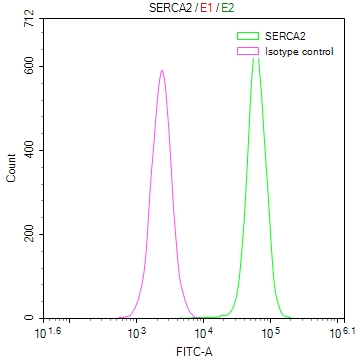
The recombinant antibody against ATP2A2 was produced using a synthesized peptide derived from Human ATP2A2 as the immunogen. This antibody exists as a non-conjugated isotype Rabbit IgG, Affinity-chromatography purified. This antibody has been validated on ELISA, IHC, IF, FC.
$350.00
| Cat.No | ADC-56520A | Clonality | Monoclonal |
|---|---|---|---|
| Target Name | ATP2A2 | Target Synonyms | ATP2A2, ATP2B, Sarcoplasmic/endoplasmic reticulum calcium ATPase 2 (SERCA2) (SR Ca(2+)-ATPase 2) (EC 3.6.3.8) (Calcium pump 2) (Calcium-transporting ATPase sarcoplasmic reticulum type, slow twitch skeletal muscle isoform) (Endoplasmic reticulum class 1/2 Ca(2+) ATPase) |
| Form | Liquid | Species Reactivity | Human |
| Isotype | Rabbit IgG | Storage Buffer | PH 7.4, 0.02% sodium azide and 50% glycerol., 150mM NaCl, Rabbit IgG in phosphate buffered saline |
| Purification Method | Affinity-chromatography purified | Conjugate | Non-conjugated |
| Application | ELISA, IF, IHC, FC | Storage | Upon receipt |
| Immunogen Description | A synthesized peptide derived from Human ATP2A2 | Target Species | Human |
|---|---|---|---|
| Immunogen Sequence | Complete sequences for the immunogen, target protein, and peptides are available upon request. | Uniprot ID | P16615 |
Uniprot Id
P16615
Target Species
Human
Target Name
ATP2A2
Target Full Name
Sarcoplasmic/endoplasmic reticulum calcium ATPase 2
Target Function
This magnesium-dependent enzyme catalyzes the hydrolysis of ATP coupled with the translocation of calcium from the cytosol to the sarcoplasmic reticulum lumen. Involved in autophagy in response to starvation. Upon interaction with VMP1 and activation, controls ER-isolation membrane contacts for autophagosome formation. Also modulates ER contacts with lipid droplets, mitochondria and endosomes.; Involved in the regulation of the contraction/relaxation cycle. Acts as a regulator of TNFSF11-mediated Ca(2+) signaling pathways via its interaction with TMEM64 which is critical for the TNFSF11-induced CREB1 activation and mitochondrial ROS generation necessary for proper osteoclast generation. Association between TMEM64 and SERCA2 in the ER leads to cytosolic Ca(2+) spiking for activation of NFATC1 and production of mitochondrial ROS, thereby triggering Ca(2+) signaling cascades that promote osteoclast differentiation and activation.
Target Involvement
Acrokeratosis verruciformis (AKV); Darier disease (DD)
Target Subcellular Location
Endoplasmic reticulum membrane; Multi-pass membrane protein. Sarcoplasmic reticulum membrane; Multi-pass membrane protein.
Target Protein Families
Cation transport ATPase (P-type) (TC 3.A.3) family, Type IIA subfamily
Target Tissue Specificity
Isoform 1 is widely expressed in smooth muscle and nonmuscle tissues such as in adult skin epidermis, with highest expression in liver, pancreas and lung, and intermediate expression in brain, kidney and placenta. Also expressed at lower levels in heart a
Target Research Area
Cardiovascular
Target Synonyms
AT2A2_HUMAN; Atp2a2; ATP2B; ATPase Ca++ transporting cardiac muscle slow twitch 2; Calcium pump 2; Calcium-transporting ATPase sarcoplasmic reticulum type; Calcium-transporting ATPase sarcoplasmic reticulum type slow twitch skeletal muscle isoform; Cardiac Ca2+ ATPase; DAR; DD; Endoplasmic reticulum class 1/2 Ca(2+) ATPase; MGC45367; Sarcoplasmic/endoplasmic reticulum calcium ATPase 2; SERCA 2; SERCA2; serca2a; slow twitch skeletal muscle isoform; SR Ca(2+)-ATPase 2
Target Background
This gene encodes one of the SERCA Ca(2+)-ATPases, which are intracellular pumps located in the sarcoplasmic or endoplasmic reticula of the skeletal muscle. This enzyme catalyzes the hydrolysis of ATP coupled with the translocation of calcium from the cytosol into the sarcoplasmic reticulum lumen, and is involved in regulation of the contraction/relaxation cycle. Mutations in this gene cause Darier-White disease, also known as keratosis follicularis, an autosomal dominant skin disorder characterized by loss of adhesion between epidermal cells and abnormal keratinization. Other types of mutations in this gene have been associated with various forms of muscular dystrophies. Alternative splicing results in multiple transcript variants encoding different isoforms.
Notification