-
Chinese (Simplified)
-
English
-
German
-
Korean
-
Spanish
Chinese (Simplified)
English
German
Korean
Spanish
Sign up for an account to enjoy easy online shopping and instant order tracking.
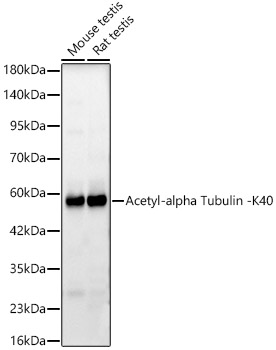
The antibody against Acetyl-alpha Tubulin -K40 was raised in Rabbit using a synthetic acetylated peptide around K40 of human alpha Tubulin(NP_001257328.1) as the immunogen. The monoclonal antibody exists as a isotype IgG, by affinity purification. This antibody has been validated on WB, IHC-P, IF/ICC, ELISA.
| Cat.No | ADA-16438A | Clonality | Monoclonal |
|---|---|---|---|
| Host Species | Rabbit | Target Name | Acetyl-alpha Tubulin -K40 |
| Target Synonyms | LIS3; TUBA3; B-ALPHA-1; Acetyl-alpha Tubulin -K40 | Form | Liquid |
| Species Reactivity | Human, Mouse, Rat | Isotype | IgG |
| Storage Buffer | 50% Glycerol, 0.05% BSA, PBS with 0.05% proclin300, pH7.3. | Purification Method | Affinity purification |
| Positive Samples | Mouse testis, Rat testis | Application | ELISA, WB, IF/ICC, IHC-P |
| Immunogen Description | A synthetic acetylated peptide around K40 of human alpha Tubulin(NP_001257328.1). | Target Species | Human |
|---|---|---|---|
| Immunogen Sequence | C-DGQNlePSDK(Ac)TIGG | Uniprot ID | Q71U36 |
Uniprot Id
Q71U36
Target Species
Human
Target Name
TUBA1A
Target Full Name
Tubulin alpha-1A chain
Target Function
Tubulin is the major constituent of microtubules. It binds two moles of GTP, one at an exchangeable site on the beta chain and one at a non-exchangeable site on the alpha chain.
Target Involvement
Lissencephaly 3 (LIS3)
Target Subcellular Location
Cytoplasm, cytoskeleton.
Target Protein Families
Tubulin family
Target Tissue Specificity
Expressed at a high level in fetal brain.
Target Synonyms
Alpha tubulin 3; Alpha-tubulin 3; B alpha 1; FLJ25113; LIS3; TBA1A_HUMAN; TUBA1A; TUBA3; Tubulin alpha 1a; Tubulin alpha 1A chain; Tubulin alpha 3; Tubulin alpha 3 chain; Tubulin alpha brain specific; Tubulin alpha-1A chain; Tubulin alpha-3 chain; Tubulin B alpha 1; Tubulin B-alpha-1
Target Background
Microtubules of the eukaryotic cytoskeleton perform essential and diverse functions and are composed of a heterodimer of alpha and beta tubulins. The genes encoding these microtubule constituents belong to the tubulin superfamily, which is composed of six distinct families. Genes from the alpha, beta and gamma tubulin families are found in all eukaryotes. The alpha and beta tubulins represent the major components of microtubules, while gamma tubulin plays a critical role in the nucleation of microtubule assembly. There are multiple alpha and beta tubulin genes, which are highly conserved among species. This gene encodes alpha tubulin and is highly similar to the mouse and rat Tuba1 genes. Northern blot studies have shown that the gene expression is predominantly found in morphologically differentiated neurologic cells. This gene is one of three alpha-tubulin genes in a cluster on chromosome 12q. Mutations in this gene cause lissencephaly type 3 (LIS3) - a neurological condition characterized by microcephaly, intellectual disability, and early-onset epilepsy caused by defective neuronal migration. Alternative splicing results in multiple transcript variants encoding distinct isoforms.
Notification