-
Chinese (Simplified)
-
English
-
German
-
Korean
-
Spanish

Chinese (Simplified)
English
German
Korean
Spanish
Sign up for an account to enjoy easy online shopping and instant order tracking.
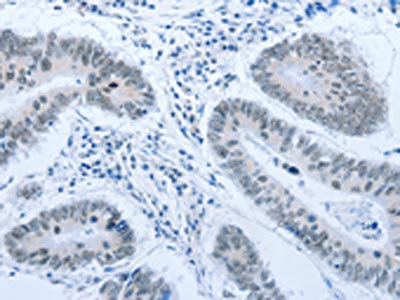
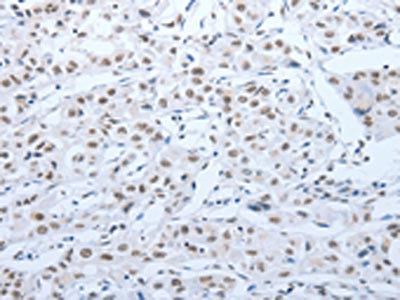
The antibody against ACIN1 was raised in rabbit using the Synthetic peptide of Human ACIN1 as the immunogen. This antibody exists as a non-conjugated isotype IgG, Antigen affinity purified. This antibody has been validated on ELISA, WB, IHC.
$299.00
| Cat.No | ADC-28892A | Clonality | Polyclonal |
|---|---|---|---|
| Host Species | Rabbit | Target Name | ACIN1 |
| Form | Liquid | Species Reactivity | Human, Mouse |
| Isotype | IgG | Storage Buffer | 0.05% NaN3, 40% Glycerol., pH7.4 PBS |
| Purification Method | Antigen affinity purified | Conjugate | Non-conjugated |
| Application | ELISA, IHC, WB | Storage | Upon receipt |
| Immunogen Description | Synthetic peptide of Human ACIN1 | Target Species | Human |
|---|---|---|---|
| Immunogen Sequence | Complete sequences for the immunogen, target protein, and peptides are available upon request. | Uniprot ID | Q9UKV3 |
Uniprot Id
Q9UKV3
Target Species
Human
Target Name
ACIN1
Target Full Name
Apoptotic chromatin condensation inducer in the nucleus
Target Function
Auxiliary component of the splicing-dependent multiprotein exon junction complex (EJC) deposited at splice junction on mRNAs. The EJC is a dynamic structure consisting of core proteins and several peripheral nuclear and cytoplasmic associated factors that join the complex only transiently either during EJC assembly or during subsequent mRNA metabolism. Component of the ASAP complexes which bind RNA in a sequence-independent manner and are proposed to be recruited to the EJC prior to or during the splicing process and to regulate specific excision of introns in specific transcription subsets; ACIN1 confers RNA-binding to the complex. The ASAP complex can inhibit RNA processing during in vitro splicing reactions. The ASAP complex promotes apoptosis and is disassembled after induction of apoptosis. Involved in the splicing modulation of BCL2L1/Bcl-X (and probably other apoptotic genes); specifically inhibits formation of proapoptotic isoforms such as Bcl-X(S); the activity is different from the established EJC assembly and function. Induces apoptotic chromatin condensation after activation by CASP3. Regulates cyclin A1, but not cyclin A2, expression in leukemia cells.
Target Subcellular Location
Nucleus. Nucleus speckle. Nucleus, nucleoplasm. Note=Phosphorylation on Ser-1180 by SRPK2 redistributes it from the nuclear speckles to the nucleoplasm.
Target Tissue Specificity
Ubiquitous. The Ser-1180 phosphorylated form (by SRPK2) is highly expressed and phosphorylated in patients with myeloid hematologic malignancies.
Target Synonyms
ACIN 1; ACIN1; ACINU_HUMAN; Acinus; ACN; Apoptotic chromatin condensation inducer 1; Apoptotic chromatin condensation inducer in the nucleus; DKFZp667N107; fSAP152; functional spliceosome-associated protein 152; KIAA0670
Notification