• Contact info@abtriva.com for inquiries and orders.
  • Chinese (Simplified)

  • English

  • German

  • Korean

  • Spanish

United States (English / $ USD)

Rabbit anti-Human AIRE Polyclonal Antibody

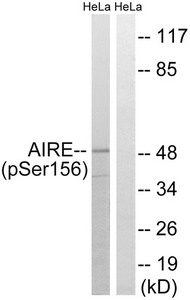
The antibody against AIRE was raised in rabbit using the Peptide sequence around phosphorylation site of Serine156 P-G-S(p)-Q-L) derived from Human AIRE. as the immunogen. Antibodies were produced by immunizing rabbits with synthetic phosphopeptide and KLH conjugates. Antibodies were purified by affinity-chromatography using epitope-specific phosphopeptide. Non-phospho specific antibodies were removed by chromatogramphy usi This antibody has been validated on ELISA, WB.

ADC-42704A

The antibody against AIRE was raised in rabbit using the Peptide sequence around phosphorylation site of Serine156 P-G-S(p)-Q-L) derived from Human AIRE. as the immunogen. Antibodies were produced by immunizing rabbits with synthetic phosphopeptide and KLH conjugates. Antibodies were purified by affinity-chromatography using epitope-specific phosphopeptide. Non-phospho specific antibodies were removed by chromatogramphy usi This antibody has been validated on ELISA, WB.

$360.00

Number
Order Exclusive Products Now

Request a Quote
High Purity LevelsPrecision and ReliabilityCustomization Options

Specifications


Cat.No ADC-42704A ClonalityPolyclonal
Host SpeciesRabbitTarget NameAIRE
FormLiquidSpecies ReactivityHuman
Storage BufferPH 7.4, 0.02% sodium azide and 50% glycerol., 150mM NaCl, Rabbit IgG in phosphate buffered saline (without Mg2+ and Ca2+)ApplicationELISA, WB
StorageUpon receipt

Immunogen Information


Immunogen DescriptionPeptide sequence around phosphorylation site of Serine156 P-G-S(p)-Q-L) derived from Human AIRE.Target SpeciesHuman
Immunogen SequenceComplete sequences for the immunogen, target protein, and peptides are available upon request.Uniprot IDO43918
Background Information
  • Uniprot Id

    O43918

  • Target Species

    Human

  • Target Name

    AIRE

  • Target Full Name

    Autoimmune regulator

  • Target Function

    Transcription factor playing an essential role to promote self-tolerance in the thymus by regulating the expression of a wide array of self-antigens that have the commonality of being tissue-restricted in their expression pattern in the periphery, called tissue restricted antigens (TRA). Binds to G-doublets in an A/T-rich environment; the preferred motif is a tandem repeat of 5'-ATTGGTTA-3' combined with a 5'-TTATTA-3' box. Binds to nucleosomes. Binds to chromatin and interacts selectively with histone H3 that is not methylated at 'Lys-4', not phosphorylated at 'Thr-3' and not methylated at 'Arg-2'. Functions as a sensor of histone H3 modifications that are important for the epigenetic regulation of gene expression. Mainly expressed by medullary thymic epithelial cells (mTECs), induces the expression of thousands of tissue-restricted proteins, which are presented on major histocompatibility complex class I (MHC-I) and MHC-II molecules to developing T-cells percolating through the thymic medulla. Also induces self-tolerance through other mechanisms such as the regulation of the mTEC differentiation program. Controls the medullary accumulation of thymic dendritic cells and the development of regulatory T-cell through the regulation of XCL1 expression. Regulates the production of CCR4 and CCR7 ligands in medullary thymic epithelial cells and alters the coordinated maturation and migration of thymocytes. In thimic B-cells, allows the presentation of licensing-dependent endogenous self-anitgen for negative selection. In secondary lymphoid organs, induces functional inactivation of CD4(+) T-cells. Expressed by a distinct bone marrow-derived population, induces self-tolerance through a mechanism that does not require regulatory T-cells and is resitant to innate inflammatory stimuli.

  • Target Involvement

    Autoimmune polyendocrine syndrome 1, with or without reversible metaphyseal dysplasia (APS1)

  • Target Subcellular Location

    Nucleus. Cytoplasm.

  • Target Tissue Specificity

    Widely expressed. Expressed at higher level in thymus (medullary epithelial cells and monocyte-dendritic cells), pancreas, adrenal cortex and testis. Expressed at lower level in the spleen, fetal liver and lymph nodes. In secondary lymphoid organs, expres

  • Target Synonyms

    AIRE; AIRE_HUMAN; AIRE1; APECED; APECED protein; APS1; APSI; Autoimmune polyendocrinopathy candidiasis ectodermal dystrophy protein; Autoimmune regulator; Autoimmune regulator protein; PGA1

  • Target Background

    This gene encodes a transcriptional regulator that forms nuclear bodies and interacts with the transcriptional coactivator CREB binding protein. The encoded protein plays an important role in immunity by regulating the expression of autoantigens and negative selection of autoreactive T-cells in the thymus. Mutations in this gene cause the rare autosomal-recessive systemic autoimmune disease termed autoimmune polyendocrinopathy with candidiasis and ectodermal dystrophy (APECED).

Inquire Rabbit anti-Human AIRE Polyclonal Antibody Now


AbTriva respects your privacy and protects your personal data in accordance with AbTriva. For more information, please see our data protection statement. *

Notification