-
Chinese (Simplified)
-
English
-
German
-
Korean
-
Spanish
Chinese (Simplified)
English
German
Korean
Spanish
Sign up for an account to enjoy easy online shopping and instant order tracking.
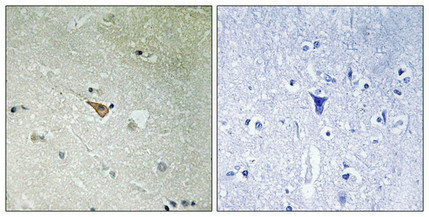
The antibody against ALK was raised in rabbit using the Peptide sequence around phosphorylation site of tyrosine 1096 (P-N-Y(p)-C-F) derived from Human ALK. as the immunogen. Antibodies were produced by immunizing rabbits with synthetic phosphopeptide and KLH conjugates. Antibodies were purified by affinity-chromatography using epitope-specific phosphopeptide. Non-phospho specific antibodies were removed by chromatogramphy usi This antibody has been validated on ELISA, IHC.
$360.00
| Cat.No | ADC-42750A | Clonality | Polyclonal |
|---|---|---|---|
| Host Species | Rabbit | Target Name | ALK |
| Form | Liquid | Species Reactivity | Human, Mouse |
| Storage Buffer | PH 7.4, 0.02% sodium azide and 50% glycerol., 150mM NaCl, Rabbit IgG in phosphate buffered saline (without Mg2+ and Ca2+) | Application | ELISA, IHC |
| Storage | Upon receipt |
| Immunogen Description | Peptide sequence around phosphorylation site of tyrosine 1096 (P-N-Y(p)-C-F) derived from Human ALK. | Target Species | Human |
|---|---|---|---|
| Immunogen Sequence | Complete sequences for the immunogen, target protein, and peptides are available upon request. | Uniprot ID | Q9UM73 |
Uniprot Id
Q9UM73
Target Species
Human
Target Name
ALK
Target Full Name
ALK tyrosine kinase receptor
Target Function
Neuronal receptor tyrosine kinase that is essentially and transiently expressed in specific regions of the central and peripheral nervous systems and plays an important role in the genesis and differentiation of the nervous system. Transduces signals from ligands at the cell surface, through specific activation of the mitogen-activated protein kinase (MAPK) pathway. Phosphorylates almost exclusively at the first tyrosine of the Y-x-x-x-Y-Y motif. Following activation by ligand, ALK induces tyrosine phosphorylation of CBL, FRS2, IRS1 and SHC1, as well as of the MAP kinases MAPK1/ERK2 and MAPK3/ERK1. Acts as a receptor for ligands pleiotrophin (PTN), a secreted growth factor, and midkine (MDK), a PTN-related factor, thus participating in PTN and MDK signal transduction. PTN-binding induces MAPK pathway activation, which is important for the anti-apoptotic signaling of PTN and regulation of cell proliferation. MDK-binding induces phosphorylation of the ALK target insulin receptor substrate (IRS1), activates mitogen-activated protein kinases (MAPKs) and PI3-kinase, resulting also in cell proliferation induction. Drives NF-kappa-B activation, probably through IRS1 and the activation of the AKT serine/threonine kinase. Recruitment of IRS1 to activated ALK and the activation of NF-kappa-B are essential for the autocrine growth and survival signaling of MDK. Thinness gene involved in the resistance to weight gain: in hypothalamic neurons, controls energy expenditure acting as a negative regulator of white adipose tissue lipolysis and sympathetic tone to fine-tune energy homeostasis.
Target Involvement
Neuroblastoma 3 (NBLST3)
Target Subcellular Location
Cell membrane; Single-pass type I membrane protein. Note=Membrane attachment was crucial for promotion of neuron-like differentiation and cell proliferation arrest through specific activation of the MAP kinase pathway.
Target Protein Families
Protein kinase superfamily, Tyr protein kinase family, Insulin receptor subfamily
Target Tissue Specificity
Expressed in brain and CNS. Also expressed in the small intestine and testis, but not in normal lymphoid cells.
Target Synonyms
Alk; ALK tyrosine kinase receptor; ALK/EML4 fusion gene; included; ALK/NPM1 fusion gene; included; ALK_HUMAN; anaplastic lymphoma kinase (Ki-1); Anaplastic lymphoma kinase; Anaplastic lymphoma kinase Ki1; anaplastic lymphoma receptor tyrosine kinase; CD 246; CD246; CD246 antigen; EC 2.7.10.1; Ki 1; Ki1; mutant anaplastic lymphoma kinase; NBLST 3; NBLST3; Tcrz; TFG/ALK
Target Background
This gene encodes a receptor tyrosine kinase, which belongs to the insulin receptor superfamily. This protein comprises an extracellular domain, an hydrophobic stretch corresponding to a single pass transmembrane region, and an intracellular kinase domain. It plays an important role in the development of the brain and exerts its effects on specific neurons in the nervous system. This gene has been found to be rearranged, mutated, or amplified in a series of tumours including anaplastic large cell lymphomas, neuroblastoma, and non-small cell lung cancer. The chromosomal rearrangements are the most common genetic alterations in this gene, which result in creation of multiple fusion genes in tumourigenesis, including ALK (chromosome 2)/EML4 (chromosome 2), ALK/RANBP2 (chromosome 2), ALK/ATIC (chromosome 2), ALK/TFG (chromosome 3), ALK/NPM1 (chromosome 5), ALK/SQSTM1 (chromosome 5), ALK/KIF5B (chromosome 10), ALK/CLTC (chromosome 17), ALK/TPM4 (chromosome 19), and ALK/MSN (chromosome X).
Notification