• Contact info@abtriva.com for inquiries and orders.
  • Chinese (Simplified)

  • English

  • German

  • Korean

  • Spanish

United States (English / $ USD)

Rabbit anti-Human ALOX15 Polyclonal Antibody

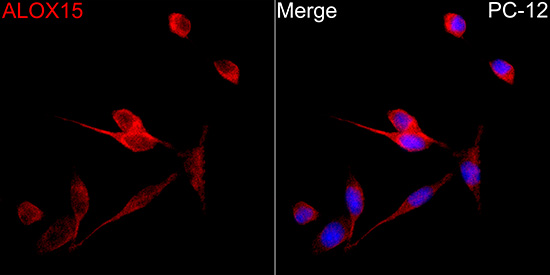
The antibody against ALOX15 was raised in Rabbit using a synthetic peptide corresponding to a sequence within amino acids 150-250 of human ALOX15(NP_001131.3) as the immunogen. The polyclonal antibody exists as a isotype IgG, by affinity purification. This antibody has been validated on IF/ICC, ELISA.

ADA-08376A

The antibody against ALOX15 was raised in Rabbit using a synthetic peptide corresponding to a sequence within amino acids 150-250 of human ALOX15(NP_001131.3) as the immunogen. The polyclonal antibody exists as a isotype IgG, by affinity purification. This antibody has been validated on IF/ICC, ELISA.

Number
Order Exclusive Products Now

Request a Quote
High Purity LevelsPrecision and ReliabilityCustomization Options

Specifications


Cat.No ADA-08376A ClonalityPolyclonal
Host SpeciesRabbitTarget NameALOX15
Target SynonymsLOG15; 12-LOX; 15-LOX; 15-LOX-1FormLiquid
Species ReactivityHuman, RatIsotypeIgG
Storage Buffer50% Glycerol, PBS with 0.05% proclin300, pH7.3.Purification MethodAffinity purification
ApplicationELISA, IF/ICC

Immunogen Information


Immunogen DescriptionA synthetic peptide corresponding to a sequence within amino acids 150-250 of human ALOX15(NP_001131.3).Target SpeciesHuman
Immunogen SequenceLNMAGAKLYDLPVDERFLEDKRVDFEVSLAKGLADLAIKDSLNVLTCWKDLDDFNRIFWCGQSKLAERVRDSWKEDALFGYQFLNGANPVVLRRSAHLPARUniprot IDP16050
Background Information
  • Uniprot Id

    P16050

  • Target Species

    Human

  • Target Name

    ALOX15

  • Target Full Name

    Polyunsaturated fatty acid lipoxygenase ALOX15

  • Target Function

    Non-heme iron-containing dioxygenase that catalyzes the stereo-specific peroxidation of free and esterified polyunsaturated fatty acids generating a spectrum of bioactive lipid mediators. It inserts peroxyl groups at C12 or C15 of arachidonate ((5Z,8Z,11Z,14Z)-eicosatetraenoate) producing both 12-hydroperoxyeicosatetraenoate/12-HPETE and 15-hydroperoxyeicosatetraenoate/15-HPETE. It may then act on 12-HPETE to produce hepoxilins, which may show proinflammatory properties. Can also peroxidize linoleate ((9Z,12Z)-octadecadienoate) to 13-hydroperoxyoctadecadienoate/13-HPODE. May participate in the sequential oxidations of DHA ((4Z,7Z,10Z,13Z,16Z,19Z)-docosahexaenoate) to generate specialized pro-resolving mediators (SPMs)like resolvin D5 ((7S,17S)-diHPDHA) and (7S,14S)-diHPDHA, that actively downregulate the immune response and have anti-aggregation properties with platelets. Can convert epoxy fatty acids to hydroperoxy-epoxides derivatives followed by an intramolecular nucleophilic substitution leading to the formation of monocyclic endoperoxides. Plays an important role during the maintenance of self-tolerance by peroxidizing membrane-bound phosphatidylethanolamine which can then signal the sorting process for clearance of apoptotic cells during inflammation and prevent an autoimmune response. In addition to its role in the immune and inflammatory responses, this enzyme may play a role in epithelial wound healing in the cornea through production of lipoxin A4 (LXA(4)) and docosahexaenoic acid-derived neuroprotectin D1 (NPD1; 10R,17S-HDHA), both lipid autacoids exhibit anti-inflammatory and neuroprotective properties. Furthermore, it may regulate actin polymerization which is crucial for several biological processes such as the phagocytosis of apoptotic cells. It is also implicated in the generation of endogenous ligands for peroxisome proliferator activated receptor (PPAR-gamma), hence modulating macrophage development and function. It may also exert a negative effect on skeletal development by regulating bone mass through this pathway. As well as participates in ER stress and downstream inflammation in adipocytes, pancreatic islets, and liver. Finally, it is also involved in the cellular response to IL13/interleukin-13.

  • Target Involvement

    Disease susceptibility may be associated with variations affecting the gene represented in this entry. Met at position 560 may confer interindividual susceptibility to coronary artery disease (CAD) (PubMed:17959182).

  • Target Subcellular Location

    Cytoplasm, cytosol. Cell membrane; Peripheral membrane protein. Lipid droplet.

  • Target Protein Families

    Lipoxygenase family

  • Target Tissue Specificity

    Detected in monocytes and eosinophils (at protein level). Expressed in airway epithelial cells.

  • Target Synonyms

    15 lipoxygenase 1; 15 LIPOXYGENASE RETICULOCYTE ARACHIDONATE; 15 LOX ; 15 LOX 1; 15-LOX; 15LOX 1; ALOX15; Arachidonate 15 lipoxygenase ; Arachidonate 15-lipoxygenase; Arachidonate omega 6 lipoxygenase; Arachidonate omega-6 lipoxygenase; LOG15; LOX15_HUMAN

  • Target Background

    This gene encodes a member of the lipoxygenase family of proteins. The encoded enzyme acts on various polyunsaturated fatty acid substrates to generate various bioactive lipid mediators such as eicosanoids, hepoxilins, lipoxins, and other molecules. The encoded enzyme and its reaction products have been shown to regulate inflammation and immunity. Multiple pseudogenes of this gene have been identified in the human genome.

Inquire Rabbit anti-Human ALOX15 Polyclonal Antibody Now


AbTriva respects your privacy and protects your personal data in accordance with AbTriva. For more information, please see our data protection statement. *

Notification