-
Chinese (Simplified)
-
English
-
German
-
Korean
-
Spanish
Chinese (Simplified)
English
German
Korean
Spanish
Sign up for an account to enjoy easy online shopping and instant order tracking.
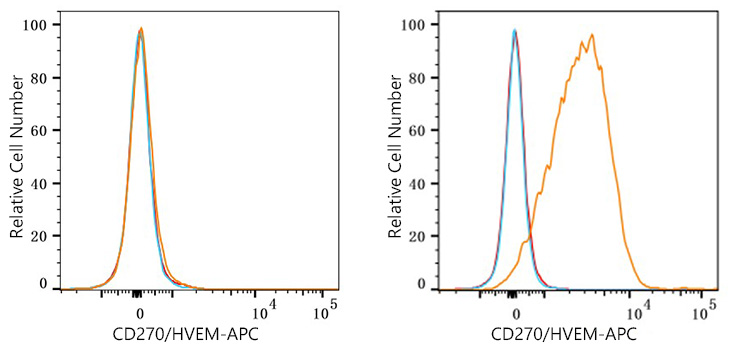
The antibody against APC was raised in Rabbit using the recombinant fusion protein containing a sequence corresponding to amino acids 39-162 of human CD270/HVEM(NP_003811.2) as the immunogen. The monoclonal antibody exists as a isotype IgG, by affinity purification. This antibody has been validated on FC.
| Cat.No | ADA-08520A | Clonality | Monoclonal |
|---|---|---|---|
| Host Species | Rabbit | Target Name | APC |
| Target Synonyms | TNFRSF14; ATAR; CD270; HVEA; HVEM; LIGHTR; TR2; TNF receptor superfamily member 14 | Form | Liquid |
| Species Reactivity | Human | Isotype | IgG |
| Storage Buffer | 0.2% BSA, PBS with 0.03% proclin300, pH7.3. | Purification Method | Affinity purification |
| Application | FC |
| Immunogen Description | Recombinant fusion protein containing a sequence corresponding to amino acids 39-162 of human CD270/HVEM(NP_003811.2) | Target Species | Human |
|---|---|---|---|
| Immunogen Sequence | LPSCKEDEYPVGSECCPKCSPGYRVKEACGELTGTVCEPCPPGTYIAHLNGLSKCLQCQMCDPAMGLRASRNCSRTENAVCGCSPGHFCIVQDGDHCAACRAYATSSPGQRVQKGGTESQDTLC | Uniprot ID | Q92956 |
Uniprot Id
Q92956
Target Species
Human
Target Name
TNFRSF14
Target Full Name
Tumor necrosis factor receptor superfamily member 14
Target Function
Receptor for four distinct ligands: The TNF superfamily members TNFSF14/LIGHT and homotrimeric LTA/lymphotoxin-alpha and the immunoglobulin superfamily members BTLA and CD160, altogether defining a complex stimulatory and inhibitory signaling network. Signals via the TRAF2-TRAF3 E3 ligase pathway to promote immune cell survival and differentiation. Participates in bidirectional cell-cell contact signaling between antigen presenting cells and lymphocytes. In response to ligation of TNFSF14/LIGHT, delivers costimulatory signals to T cells, promoting cell proliferation and effector functions. Interacts with CD160 on NK cells, enhancing IFNG production and anti-tumor immune response. In the context of bacterial infection, acts as a signaling receptor on epithelial cells for CD160 from intraepithelial lymphocytes, triggering the production of antimicrobial proteins and proinflammatory cytokines. Upon binding to CD160 on activated CD4+ T cells, downregulates CD28 costimulatory signaling, restricting memory and alloantigen-specific immune response. May interact in cis (on the same cell) or in trans (on other cells) with BTLA. In cis interactions, appears to play an immune regulatory role inhibiting in trans interactions in naive T cells to maintain a resting state. In trans interactions, can predominate during adaptive immune response to provide survival signals to effector T cells.; (Microbial infection) Acts as a receptor for Herpes simplex virus 1/HHV-1.; (Microbial infection) Acts as a receptor for Herpes simplex virus 2/HHV-2
Target Subcellular Location
Cell membrane; Single-pass type I membrane protein.
Target Tissue Specificity
Widely expressed, with the highest expression in lung, spleen and thymus. Expressed in a subpopulation of B cells and monocytes. Expressed in naive T cells.
Target Synonyms
HVEML; ATAR; CD270; CD40 like protein precursor; Herpes virus entry mediator A; Herpesvirus entry mediator A; Herpesvirus entry mediator; Herpesvirus entry mediator ligand; HveA; HVEM; HVEM L; LIGHT; LIGHTR; TNFRSF14; TNFSF 14; TNR14_HUMAN; TR2; Tumor necrosis factor receptor like gene2; Tumor necrosis factor receptor superfamily member 14; Tumor necrosis factor receptor superfamily member 14 precursor; Tumor necrosis factor receptor-like 2
Notification