-
Chinese (Simplified)
-
English
-
German
-
Korean
-
Spanish
Chinese (Simplified)
English
German
Korean
Spanish
Sign up for an account to enjoy easy online shopping and instant order tracking.
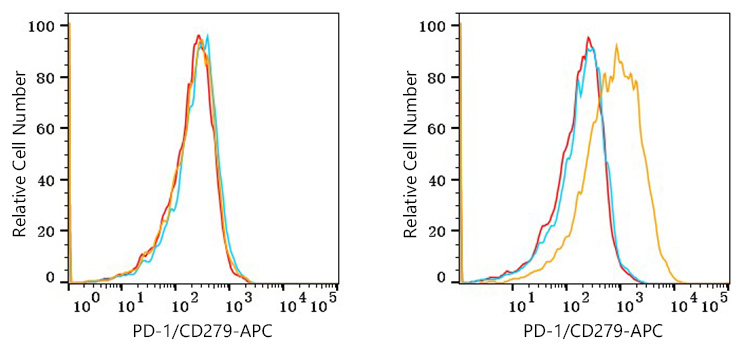
The antibody against APC was raised in Rabbit using the recombinant fusion protein containing a sequence corresponding to amino acids 25-168 of human PD-1/CD279 (NP_005009.2) as the immunogen. The monoclonal antibody exists as a isotype IgG, by affinity purification. This antibody has been validated on FC.
| Cat.No | ADA-08569A | Clonality | Monoclonal |
|---|---|---|---|
| Host Species | Rabbit | Target Name | APC |
| Target Synonyms | PD1; PD-1; CD279; SLEB2; hPD-1; hPD-l; hSLE1 | Form | Liquid |
| Species Reactivity | Human | Isotype | IgG |
| Storage Buffer | 0.2% BSA, PBS with 0.03% proclin300, pH7.3. | Purification Method | Affinity purification |
| Application | FC |
| Immunogen Description | Recombinant fusion protein containing a sequence corresponding to amino acids 25-168 of human PD-1/CD279 (NP_005009.2). | Target Species | Human |
|---|---|---|---|
| Immunogen Sequence | LDSPDRPWNPPTFSPALLVVTEGDNATFTCSFSNTSESFVLNWYRMSPSNQTDKLAAFPEDRSQPGQDCRFRVTQLPNGRDFHMSVVRARRNDSGTYLCGAISLAPKAQIKESLRAELRVTERRAEVPTAHPSPSPRPAGQFQT | Uniprot ID | Q15116 |
Uniprot Id
Q15116
Target Species
Human
Target Name
PDCD1
Target Full Name
Programmed cell death protein 1
Target Function
Inhibitory receptor on antigen activated T-cells that plays a critical role in induction and maintenance of immune tolerance to self. Delivers inhibitory signals upon binding to ligands CD274/PDCD1L1 and CD273/PDCD1LG2. Following T-cell receptor (TCR) engagement, PDCD1 associates with CD3-TCR in the immunological synapse and directly inhibits T-cell activation. Suppresses T-cell activation through the recruitment of PTPN11/SHP-2: following ligand-binding, PDCD1 is phosphorylated within the ITSM motif, leading to the recruitment of the protein tyrosine phosphatase PTPN11/SHP-2 that mediates dephosphorylation of key TCR proximal signaling molecules, such as ZAP70, PRKCQ/PKCtheta and CD247/CD3zeta.; The PDCD1-mediated inhibitory pathway is exploited by tumors to attenuate anti-tumor immunity and escape destruction by the immune system, thereby facilitating tumor survival. The interaction with CD274/PDCD1L1 inhibits cytotoxic T lymphocytes (CTLs) effector function. The blockage of the PDCD1-mediated pathway results in the reversal of the exhausted T-cell phenotype and the normalization of the anti-tumor response, providing a rationale for cancer immunotherapy.
Target Involvement
Systemic lupus erythematosus 2 (SLEB2)
Target Subcellular Location
Cell membrane; Single-pass type I membrane protein.
Target Research Area
Cell Biology
Target Synonyms
CD279; CD279 antigen; hPD 1; hPD l; hPD-1; hSLE1; PD 1; PD-1; PD1; PDCD 1; PDCD1; PDCD1_HUMAN; Programmed cell death 1 ; Programmed cell death 1 protein; Programmed cell death protein 1; Protein PD 1; Protein PD-1; SLEB2 ; Systemic lupus erythematosus susceptibility 2
Target Background
Programmed cell death protein 1 (PDCD1) is an immune-inhibitory receptor expressed in activated T cells; it is involved in the regulation of T-cell functions, including those of effector CD8+ T cells. In addition, this protein can also promote the differentiation of CD4+ T cells into T regulatory cells. PDCD1 is expressed in many types of tumors including melanomas, and has demonstrated to play a role in anti-tumor immunity. Moreover, this protein has been shown to be involved in safeguarding against autoimmunity, however, it can also contribute to the inhibition of effective anti-tumor and anti-microbial immunity.
Notification