-
Chinese (Simplified)
-
English
-
German
-
Korean
-
Spanish
Chinese (Simplified)
English
German
Korean
Spanish
Sign up for an account to enjoy easy online shopping and instant order tracking.
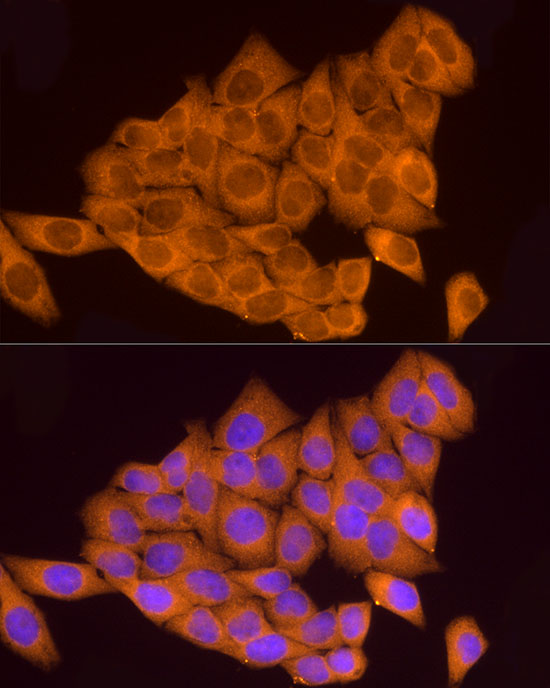
The antibody against ATP6V0A1 was raised in Rabbit using the recombinant fusion protein containing a sequence corresponding to amino acids 60-300 of human ATP6V0A1 (NP_001123493.1) as the immunogen. The polyclonal antibody exists as a isotype IgG, by affinity purification. This antibody has been validated on WB, IF/ICC, ELISA.
| Cat.No | ADA-10118A | Clonality | Polyclonal |
|---|---|---|---|
| Host Species | Rabbit | Target Name | ATP6V0A1 |
| Target Synonyms | a1; Stv1; VPP1; Vph1; ATP6N1; DEE104; NEDEBA; ATP6N1A; ATP6V0A1 | Form | Liquid |
| Species Reactivity | Human, Mouse, Rat | Isotype | IgG |
| Storage Buffer | 50% Glycerol, PBS with 0.01% thimerosal, pH7.3. | Purification Method | Affinity purification |
| Application | ELISA, WB, IF/ICC |
| Immunogen Description | Recombinant fusion protein containing a sequence corresponding to amino acids 60-300 of human ATP6V0A1 (NP_001123493.1). | Target Species | Human |
|---|---|---|---|
| Uniprot ID | Q93050 | Immunogen Sequence |
Uniprot Id
Q93050
Target Species
Human
Target Name
ATP6V0A1
Target Full Name
V-type proton ATPase 116 kDa subunit a 1
Target Function
Required for assembly and activity of the vacuolar ATPase. Potential role in differential targeting and regulation of the enzyme for a specific organelle.
Target Subcellular Location
Cytoplasmic vesicle membrane; Multi-pass membrane protein. Melanosome. Note=Coated vesicle. Identified by mass spectrometry in melanosome fractions from stage I to stage IV.
Target Protein Families
V-ATPase 116 kDa subunit family
Target Synonyms
a1; ATP6N1; ATP6N1A; ATP6V0A1; ATPase H+ transporting lysosomal (vacuolar proton pump) non catalytic accessory protein 1A (110/116kD); ATPase H+ transporting lysosomal non catalytic accessory protein 1 (110/116kD); ATPase H+ transporting lysosomal V0 subunit a1; ATPase H+ transporting V0 subunit a1; ATPase, H+ transporting, lysosomal, noncatalytic accessory protein 1A; Clathrin coated vesicle/synaptic vesicle proton pump 116 kDa subunit; Clathrin-coated vesicle/synaptic vesicle proton pump 116 kDa subunit; DKFZp781J1951; H(+) transporting two sector ATPase 116 kDa accessory protein A1; Stv1; V ATPase 116 kDa; V ATPase 116 kDa isoform a1; V type proton ATPase 116 kDa subunit a; V type proton ATPase 116 kDa subunit a isoform 1; V-ATPase 116 kDa isoform a1; V-type proton ATPase 116 kDa subunit a isoform 1; Vacuolar adenosine triphosphatase subunit Ac116; Vacuolar proton pump subunit 1; Vacuolar proton pump, subunit 1; Vacuolar proton translocating ATPase 116 kDa subunit A; Vacuolar proton translocating ATPase 116 kDa subunit a isoform 1; Vacuolar type H(+) ATPase 115 kDa subunit; Vph1; VPP1; VPP1_HUMAN
Target Background
This gene encodes a component of vacuolar ATPase (V-ATPase), a multisubunit enzyme that mediates acidification of eukaryotic intracellular organelles. V-ATPase dependent organelle acidification is necessary for such intracellular processes as protein sorting, zymogen activation, receptor-mediated endocytosis, and synaptic vesicle proton gradient generation. V-ATPase is composed of a cytosolic V1 domain and a transmembrane V0 domain. The V1 domain consists of three A and three B subunits, two G subunits plus the C, D, E, F, and H subunits. The V1 domain contains the ATP catalytic site. The V0 domain consists of five different subunits: a, c, c', c", and d. Additional isoforms of many of the V1 and V0 subunit proteins are encoded by multiple genes or alternatively spliced transcript variants. This gene encodes one of three A subunit proteins and the encoded protein is associated with clathrin-coated vesicles. Three transcript variants encoding different isoforms have been found for this gene.
Notification