-
Chinese (Simplified)
-
English
-
German
-
Korean
-
Spanish
Chinese (Simplified)
English
German
Korean
Spanish
Sign up for an account to enjoy easy online shopping and instant order tracking.
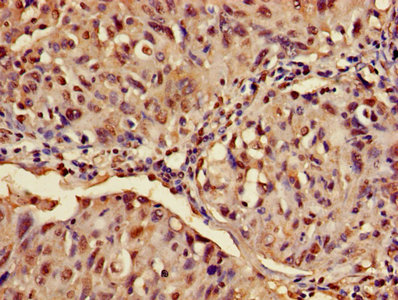
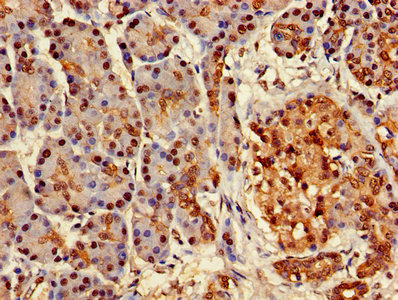
The antibody against ATXN3 was raised in rabbit using the Recombinant Human Ataxin-3 protein (1-288AA) as the immunogen. This antibody exists as a non-conjugated isotype IgG, purified by protein G with a purity greater than 95%. This antibody has been validated on ELISA, WB, IHC.
$299.00
| Cat.No | ADC-32783A | Clonality | Polyclonal |
|---|---|---|---|
| Host Species | Rabbit | Target Name | ATXN3 |
| Target Synonyms | autosomal dominant, olivopontocerebellar ataxia 3 | Form | Liquid |
| Species Reactivity | Human, Mouse | Isotype | IgG |
| Storage Buffer | 0.01M PBS, 0.03% Proclin 300; Constituents: 50% Glycerol, PH 7.4 | Purification Method | >95%, Protein G purified |
| Conjugate | Non-conjugated | Application | ELISA, IHC, WB |
| Storage | Upon receipt |
| Immunogen Description | Recombinant Human Ataxin-3 protein (1-288AA) | Target Species | Human |
|---|---|---|---|
| Immunogen Sequence | Complete sequences for the immunogen, target protein, and peptides are available upon request. | Uniprot ID | P54252 |
Uniprot Id
P54252
Target Species
Human
Target Name
ATXN3
Target Full Name
Ataxin-3
Target Function
Deubiquitinating enzyme involved in protein homeostasis maintenance, transcription, cytoskeleton regulation, myogenesis and degradation of misfolded chaperone substrates. Binds long polyubiquitin chains and trims them, while it has weak or no activity against chains of 4 or less ubiquitins. Involved in degradation of misfolded chaperone substrates via its interaction with STUB1/CHIP: recruited to monoubiquitinated STUB1/CHIP, and restricts the length of ubiquitin chain attached to STUB1/CHIP substrates and preventing further chain extension. Interacts with key regulators of transcription and represses transcription: acts as a histone-binding protein that regulates transcription. Regulates autophagy via the deubiquitination of 'Lys-402' of BECN1 leading to the stabilization of BECN1.
Target Involvement
Spinocerebellar ataxia 3 (SCA3)
Target Subcellular Location
Nucleus matrix. Nucleus. Note=Predominantly nuclear, but not exclusively, inner nuclear matrix.
Target Tissue Specificity
Ubiquitous.
Target Synonyms
AT3; Ataxin 3; ataxin 3 variant h; ataxin 3 variant m; ataxin 3 variant ref; Ataxin-3; ATX3; ATX3_HUMAN; ATXN3; EC 3.4.22.; JOS; Josephin; Machado Joseph disease (spinocerebellar ataxia 3, olivopontocerebellar ataxia 3, autosomal dominant, ataxin 3); Machado Joseph disease; Machado Joseph disease protein 1; Machado-Joseph disease protein 1; Machado-Joseph disease protein 1 homolog; MJD; MJD gene; MJD1; Olivopontocerebellar ataxia 3; OTTHUMP00000221583; OTTHUMP00000221585; OTTHUMP00000221586; OTTHUMP00000221587; OTTHUMP00000231995; OTTHUMP00000231997; Rsca3; SCA3; SCA3 gene; Spinocerebellar ataxia type 3 protein
Target Background
Machado-Joseph disease, also known as spinocerebellar ataxia-3, is an autosomal dominant neurologic disorder. The protein encoded by this gene contains (CAG)n repeats in the coding region, and the expansion of these repeats from the normal 12-44 to 52-86 is one cause of Machado-Joseph disease. There is a negative correlation between the age of onset and CAG repeat numbers. Alternatively spliced transcript variants encoding different isoforms have been described for this gene.
Notification