-
Chinese (Simplified)
-
English
-
German
-
Korean
-
Spanish
Chinese (Simplified)
English
German
Korean
Spanish
Sign up for an account to enjoy easy online shopping and instant order tracking.
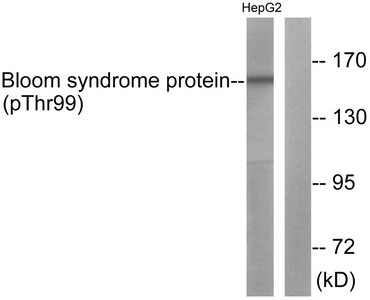
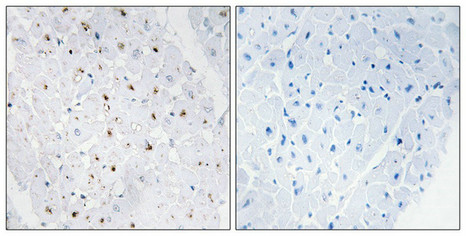
The antibody against BLM was raised in rabbit using the Peptide sequence around phosphorylation site of threonine 99 (Q-E-T(p)-Q-R) derived from Human Bloom Syndrome. as the immunogen. Antibodies were produced by immunizing rabbits with synthetic phosphopeptide and KLH conjugates. Antibodies were purified by affinity-chromatography using epitope-specific phosphopeptide. Non-phospho specific antibodies were removed by chromatogramphy usi This antibody has been validated on ELISA, WB, IHC.
$360.00
| Cat.No | ADC-42779A | Clonality | Polyclonal |
|---|---|---|---|
| Host Species | Rabbit | Target Name | BLM |
| Form | Liquid | Species Reactivity | Human |
| Storage Buffer | PH 7.4, 0.02% sodium azide and 50% glycerol., 150mM NaCl, Rabbit IgG in phosphate buffered saline (without Mg2+ and Ca2+) | Application | ELISA, IHC, WB |
| Storage | Upon receipt |
| Immunogen Description | Peptide sequence around phosphorylation site of threonine 99 (Q-E-T(p)-Q-R) derived from Human Bloom Syndrome. | Target Species | Human |
|---|---|---|---|
| Immunogen Sequence | Complete sequences for the immunogen, target protein, and peptides are available upon request. | Uniprot ID | P54132 |
Uniprot Id
P54132
Target Species
Human
Target Name
BLM
Target Full Name
RecQ-like DNA helicase BLM
Target Function
ATP-dependent DNA helicase that unwinds single- and double-stranded DNA in a 3'-5' direction. Participates in DNA replication and repair. Involved in 5'-end resection of DNA during double-strand break (DSB) repair: unwinds DNA and recruits DNA2 which mediates the cleavage of 5'-ssDNA. Negatively regulates sister chromatid exchange (SCE). Stimulates DNA 4-way junction branch migration and DNA Holliday junction dissolution. Binds single-stranded DNA (ssDNA), forked duplex DNA and DNA Holliday junction. Recruited by the KHDC3L-OOEP scaffold to DNA replication forks where it is retained by TRIM25 ubiquitination, it thereby promotes the restart of stalled replication forks.
Target Involvement
Bloom syndrome (BLM)
Target Subcellular Location
Nucleus. Note=Together with SPIDR, is redistributed in discrete nuclear DNA damage-induced foci following hydroxyurea (HU) or camptothecin (CPT) treatment. Accumulated at sites of DNA damage in a RMI complex- and SPIDR-dependent manner.
Target Protein Families
Helicase family, RecQ subfamily
Target Research Area
Others
Target Synonyms
Blm; BLM_HUMAN; Bloom syndrome; Bloom syndrome protein; Bloom syndrome RecQ helicase like; BS; DNA helicase; DNA helicase RecQ like type 2; MGC126616; MGC131618; MGC131620; RECQ 2; RECQ like; RecQ like type 2; RecQ protein like 3; RecQ protein-like 3; RecQ-like type 2; RecQ2; RECQL 2; RECQL 3; RECQL2; RECQL3; type 2
Notification