• Contact info@abtriva.com for inquiries and orders.
  • Chinese (Simplified)

  • English

  • German

  • Korean

  • Spanish

United States (English / $ USD)

Rabbit anti-Human BRCA1 Polyclonal Antibody

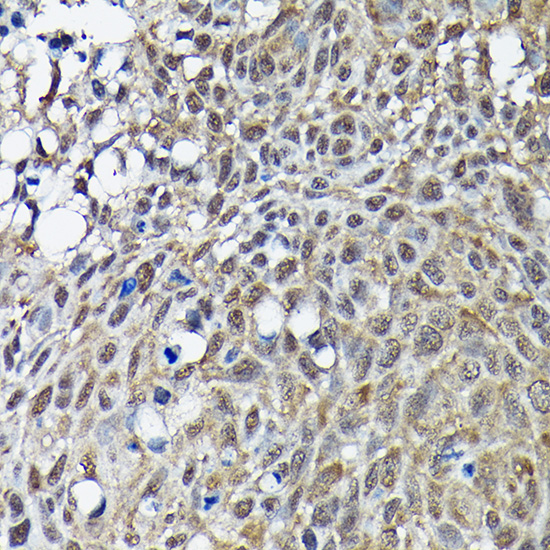
The antibody against BRCA1 was raised in Rabbit using a synthetic peptide corresponding to a sequence within amino acids 901-1000 of human BRCA1 (NP_009225.1) as the immunogen. The polyclonal antibody exists as a isotype IgG, by affinity purification. This antibody has been validated on IHC-P, IF/ICC, ELISA.

ADA-10349A

The antibody against BRCA1 was raised in Rabbit using a synthetic peptide corresponding to a sequence within amino acids 901-1000 of human BRCA1 (NP_009225.1) as the immunogen. The polyclonal antibody exists as a isotype IgG, by affinity purification. This antibody has been validated on IHC-P, IF/ICC, ELISA.

Number
Order Exclusive Products Now

Request a Quote
High Purity LevelsPrecision and ReliabilityCustomization Options

Specifications


Cat.No ADA-10349A ClonalityPolyclonal
Host SpeciesRabbitTarget NameBRCA1
Target SynonymsIRIS; PSCP; BRCAI; BRCC1; FANCS; PNCA4; RNF53; BROVCA1; PPP1R53; BRCA1FormLiquid
Species ReactivityHumanIsotypeIgG
Storage Buffer50% Glycerol, PBS with 0.02% sodium azide, pH7.3.Purification MethodAffinity purification
ApplicationELISA, IF/ICC, IHC-P

Immunogen Information


Immunogen DescriptionA synthetic peptide corresponding to a sequence within amino acids 901-1000 of human BRCA1 (NP_009225.1).Target SpeciesHuman
Immunogen SequenceFECEQKEENQGKNESNIKPVQTVNITAGFPVVGQKDKPVDNAKCSIKGGSRFCLSSQFRGNETGLITPNKHGLLQNPYRIPPLFPIKSFVKTKCKKNLLEUniprot IDP38398
Background Information
  • Uniprot Id

    P38398

  • Target Species

    Human

  • Target Name

    BRCA1

  • Target Full Name

    Breast cancer type 1 susceptibility protein

  • Target Function

    E3 ubiquitin-protein ligase that specifically mediates the formation of 'Lys-6'-linked polyubiquitin chains and plays a central role in DNA repair by facilitating cellular responses to DNA damage. It is unclear whether it also mediates the formation of other types of polyubiquitin chains. The BRCA1-BARD1 heterodimer coordinates a diverse range of cellular pathways such as DNA damage repair, ubiquitination and transcriptional regulation to maintain genomic stability. Regulates centrosomal microtubule nucleation. Required for appropriate cell cycle arrests after ionizing irradiation in both the S-phase and the G2 phase of the cell cycle. Required for FANCD2 targeting to sites of DNA damage. Inhibits lipid synthesis by binding to inactive phosphorylated ACACA and preventing its dephosphorylation. Contributes to homologous recombination repair (HRR) via its direct interaction with PALB2, fine-tunes recombinational repair partly through its modulatory role in the PALB2-dependent loading of BRCA2-RAD51 repair machinery at DNA breaks. Component of the BRCA1-RBBP8 complex which regulates CHEK1 activation and controls cell cycle G2/M checkpoints on DNA damage via BRCA1-mediated ubiquitination of RBBP8. Acts as a transcriptional activator.

  • Target Involvement

    Breast cancer (BC); Breast-ovarian cancer, familial, 1 (BROVCA1); Ovarian cancer (OC); Pancreatic cancer 4 (PNCA4)

  • Target Subcellular Location

    Nucleus. Chromosome. Cytoplasm.; [Isoform 3]: Cytoplasm.; [Isoform 5]: Cytoplasm.

  • Target Tissue Specificity

    Isoform 1 and isoform 3 are widely expressed. Isoform 3 is reduced or absent in several breast and ovarian cancer cell lines.

  • Target Research Area

    Epigenetics and Nuclear Signaling

  • Target Synonyms

    BRCA 1; BRCA1; BRCA1 DNA repair associated; BRCA1/BRCA2 containing complex subunit 1; BRCA1/BRCA2-containing complex; subunit 1; BRCA1_HUMAN; BRCAI; BRCC 1; BRCC1; Breast and ovarian cancer susceptibility protein 1; Breast Cancer 1; Breast Cancer 1 Early Onset; Breast cancer type 1 susceptibility protein; BROVCA1; FANCS; IRIS; PNCA4; PPP1R53; Protein phosphatase 1 regulatory subunit 53; PSCP; RING finger protein 53; RNF53

  • Target Background

    This gene encodes a 190 kD nuclear phosphoprotein that plays a role in maintaining genomic stability, and it also acts as a tumor suppressor. The BRCA1 gene contains 22 exons spanning about 110 kb of DNA. The encoded protein combines with other tumor suppressors, DNA damage sensors, and signal transducers to form a large multi-subunit protein complex known as the BRCA1-associated genome surveillance complex (BASC). This gene product associates with RNA polymerase II, and through the C-terminal domain, also interacts with histone deacetylase complexes. This protein thus plays a role in transcription, DNA repair of double-stranded breaks, and recombination. Mutations in this gene are responsible for approximately 40% of inherited breast cancers and more than 80% of inherited breast and ovarian cancers. Alternative splicing plays a role in modulating the subcellular localization and physiological function of this gene. Many alternatively spliced transcript variants, some of which are disease-associated mutations, have been described for this gene, but the full-length natures of only some of these variants has been described. A related pseudogene, which is also located on chromosome 17, has been identified.

Inquire Rabbit anti-Human BRCA1 Polyclonal Antibody Now


AbTriva respects your privacy and protects your personal data in accordance with AbTriva. For more information, please see our data protection statement. *

Notification