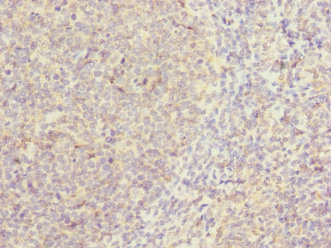
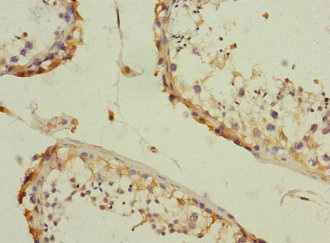
-
Chinese (Simplified)
-
English
-
German
-
Korean
-
Spanish
Chinese (Simplified)
English
German
Korean
Spanish
Sign up for an account to enjoy easy online shopping and instant order tracking.
The antibody against CAMSAP2 was raised in rabbit using the Recombinant Human Calmodulin-regulated spectrin-associated protein 2 protein (1-150AA) as the immunogen. This antibody exists as a non-conjugated isotype IgG, Antigen affinity purified. This antibody has been validated on ELISA, IHC.
$299.00
| Cat.No | ADC-16481A | Clonality | Polyclonal |
|---|---|---|---|
| Host Species | Rabbit | Target Name | CAMSAP2 |
| Target Synonyms | CAMSAP2 antibody; CAMSAP1L1 antibody; KIAA1078 antibody; Calmodulin-regulated spectrin-associated protein 2 antibody; Calmodulin-regulated spectrin-associated protein 1-like protein 1 antibody | Form | Liquid |
| Species Reactivity | Human | Isotype | IgG |
| Storage Buffer | 50% Glycerol, PBS with 0.02% sodium azide, pH7.3. | Purification Method | Antigen affinity purified |
| Conjugate | Non-conjugated | Application | ELISA, IHC |
| Storage | Upon receipt |
| Immunogen Description | Recombinant Human Calmodulin-regulated spectrin-associated protein 2 protein (1-150AA) | Target Species | Human |
|---|---|---|---|
| Immunogen Sequence | Complete sequences for the immunogen, target protein, and peptides are available upon request. | Uniprot ID | Q08AD1 |
Uniprot Id
Q08AD1
Target Species
Human
Target Name
CAMSAP2
Target Full Name
Calmodulin-regulated spectrin-associated protein 2
Target Function
Key microtubule-organizing protein that specifically binds the minus-end of non-centrosomal microtubules and regulates their dynamics and organization. Specifically recognizes growing microtubule minus-ends and autonomously decorates and stabilizes microtubule lattice formed by microtubule minus-end polymerization. Acts on free microtubule minus-ends that are not capped by microtubule-nucleating proteins or other factors and protects microtubule minus-ends from depolymerization. In addition, it also reduces the velocity of microtubule polymerization. Through the microtubule cytoskeleton, also regulates the organization of cellular organelles including the Golgi and the early endosomes. Essential for the tethering, but not for nucleation of non-centrosomal microtubules at the Golgi: together with Golgi-associated proteins AKAP9 and PDE4DIP, required to tether non-centrosomal minus-end microtubules to the Golgi, an important step for polarized cell movement. Also acts as a regulator of neuronal polarity and development: localizes to non-centrosomal microtubule minus-ends in neurons and stabilizes non-centrosomal microtubules, which is required for neuronal polarity, axon specification and dendritic branch formation. Through the microtubule cytoskeleton, regulates the autophagosome transport.
Target Involvement
Defects in CAMSAP2 may be a cause of susceptibility to epilepsy in the Chinese population.
Target Subcellular Location
Cytoplasm, cytoskeleton. Golgi apparatus. Cytoplasm, cytoskeleton, cilium basal body. Cytoplasm.
Target Protein Families
CAMSAP1 family
Target Synonyms
CAMSAP1L1; CAMSAP2
Target Background
Enables microtubule minus-end binding activity. Involved in several processes, including axon development; regulation of dendrite development; and regulation of organelle organization. Located in cytosol and microtubule end. Colocalizes with Golgi apparatus; centrosome; and microtubule minus-end.
Notification