-
Chinese (Simplified)
-
English
-
German
-
Korean
-
Spanish
Chinese (Simplified)
English
German
Korean
Spanish
Sign up for an account to enjoy easy online shopping and instant order tracking.
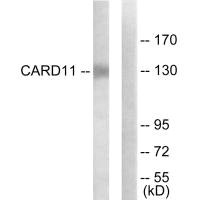
The antibody against CARD11 was raised in rabbit using the Synthesized peptide derived from internal of Human CARD11. as the immunogen. The antibody was affinity-purified from rabbit antiserum by affinity-chromatography using epitope-specific immunogen. This antibody has been validated on ELISA, WB.
$297.00
| Cat.No | ADC-41698A | Clonality | Polyclonal |
|---|---|---|---|
| Host Species | Rabbit | Target Name | CARD11 |
| Form | Liquid | Species Reactivity | Human, Mouse |
| Storage Buffer | PH 7.4, 0.02% sodium azide and 50% glycerol., 150mM NaCl, Rabbit IgG in phosphate buffered saline (without Mg2+ and Ca2+) | Purification Method | The antibody was affinity-purified from rabbit antiserum by affinity-chromatography using epitope-specific immunogen. |
| Application | ELISA, WB | Storage | Upon receipt |
| Immunogen Description | Synthesized peptide derived from internal of Human CARD11. | Target Species | Human |
|---|---|---|---|
| Immunogen Sequence | Complete sequences for the immunogen, target protein, and peptides are available upon request. | Uniprot ID | Q9BXL7 |
Uniprot Id
Q9BXL7
Target Species
Human
Target Name
CARD11
Target Full Name
Caspase recruitment domain-containing protein 11
Target Function
Adapter protein that plays a key role in adaptive immune response by transducing the activation of NF-kappa-B downstream of T-cell receptor (TCR) and B-cell receptor (BCR) engagement. Transduces signals downstream TCR or BCR activation via the formation of a multiprotein complex together with BCL10 and MALT1 that induces NF-kappa-B and MAP kinase p38 (MAPK11, MAPK12, MAPK13 and/or MAPK14) pathways. Upon activation in response to TCR or BCR triggering, CARD11 homooligomerizes to form a nucleating helical template that recruits BCL10 via CARD-CARD interaction, thereby promoting polymerization of BCL10 and subsequent recruitment of MALT1: this leads to I-kappa-B kinase (IKK) phosphorylation and degradation, and release of NF-kappa-B proteins for nuclear translocation. Its binding to DPP4 induces T-cell proliferation and NF-kappa-B activation in a T-cell receptor/CD3-dependent manner. Promotes linear ubiquitination of BCL10 by promoting the targeting of BCL10 to RNF31/HOIP. Stimulates the phosphorylation of BCL10. Also activates the TORC1 signaling pathway.
Target Involvement
B-cell expansion with NFKB and T-cell anergy (BENTA); Immunodeficiency 11 A (IMD11A); Immunodeficiency 11B with atopic dermatitis (IMD11B)
Target Subcellular Location
Cytoplasm. Membrane raft.
Target Tissue Specificity
Detected in adult peripheral blood leukocytes, thymus, spleen and liver. Also found in promyelocytic leukemia HL-60 cells, chronic myelogenous leukemia K-562 cells, Burkitt's lymphoma Raji cells and colorectal adenocarcinoma SW480 cells. Not detected in H
Target Synonyms
0610008L17Rik; 2410011D02Rik; Bcl10 interacting maguk protein 3; BIMP 3; BIMP3; CAR11_HUMAN; CARD 11; CARD containing MAGUK protein 3; Card maguk protein 1; CARD-containing MAGUK protein 1; CARD11; CARD11 protein; Carma 1; CARMA1; Caspase recruitment domain containing protein 11; Caspase recruitment domain family member 11; Caspase recruitment domain-containing protein 11; MGC133069
Target Background
The protein encoded by this gene belongs to the membrane-associated guanylate kinase (MAGUK) family, a class of proteins that functions as molecular scaffolds for the assembly of multiprotein complexes at specialized regions of the plasma membrane. This protein is also a member of the CARD protein family, which is defined by carrying a characteristic caspase-associated recruitment domain (CARD). This protein has a domain structure similar to that of CARD14 protein. The CARD domains of both proteins have been shown to specifically interact with BCL10, a protein known to function as a positive regulator of cell apoptosis and NF-kappaB activation. When expressed in cells, this protein activated NF-kappaB and induced the phosphorylation of BCL10.
Notification