-
Chinese (Simplified)
-
English
-
German
-
Korean
-
Spanish
Chinese (Simplified)
English
German
Korean
Spanish
Sign up for an account to enjoy easy online shopping and instant order tracking.
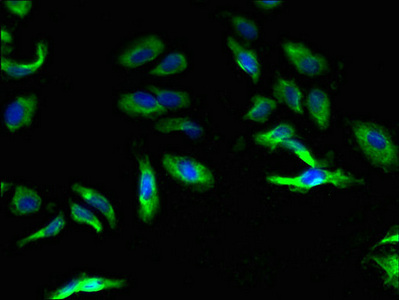
The antibody against CASR was raised in rabbit using the Recombinant Human Extracellular calcium-sensing receptor protein (20-612AA) as the immunogen. This antibody exists as a non-conjugated isotype IgG, purified by protein G with a purity greater than 95%. This antibody has been validated on ELISA, IF.
$299.00
| Cat.No | ADC-50826A | Clonality | Polyclonal |
|---|---|---|---|
| Host Species | Rabbit | Target Name | CASR |
| Form | Liquid | Species Reactivity | Human |
| Isotype | IgG | Storage Buffer | 0.01M PBS, 0.03% Proclin 300; Constituents: 50% Glycerol, PH 7.4 |
| Purification Method | >95%, Protein G purified | Conjugate | Non-conjugated |
| Application | ELISA, IF | Storage | Upon receipt |
| Immunogen Description | Recombinant Human Extracellular calcium-sensing receptor protein (20-612AA) | Target Species | Human |
|---|---|---|---|
| Immunogen Sequence | Complete sequences for the immunogen, target protein, and peptides are available upon request. | Uniprot ID | P41180 |
Uniprot Id
P41180
Target Species
Human
Target Name
CASR
Target Full Name
Extracellular calcium-sensing receptor
Target Function
G-protein-coupled receptor that senses changes in the extracellular concentration of calcium ions and plays a key role in maintaining calcium homeostasis. Senses fluctuations in the circulating calcium concentration and modulates the production of parathyroid hormone (PTH) in parathyroid glands. The activity of this receptor is mediated by a G-protein that activates a phosphatidylinositol-calcium second messenger system. The G-protein-coupled receptor activity is activated by a co-agonist mechanism: aromatic amino acids, such as Trp or Phe, act concertedly with divalent cations, such as calcium or magnesium, to achieve full receptor activation.
Target Involvement
Hypocalciuric hypercalcemia, familial 1 (HHC1); Hyperparathyroidism, neonatal severe (NSHPT); Hypocalcemia, autosomal dominant 1 (HYPOC1); Epilepsy, idiopathic generalized 8 (EIG8)
Target Subcellular Location
Cell membrane; Multi-pass membrane protein.
Target Protein Families
G-protein coupled receptor 3 family
Target Tissue Specificity
Expressed in the temporal lobe, frontal lobe, parietal lobe, hippocampus, and cerebellum. Also found in kidney, lung, liver, heart, skeletal muscle, placenta.
Target Research Area
Metabolism, Neuroscience
Target Synonyms
Ca sensing receptor; Ca2+ sensing receptor 1; Ca2+ sensing receptor; Calcium sensing receptor; CAR; CaSR; CASR_HUMAN; EIG8; Extracellular calcium sensing receptor; Extracellular calcium sensing receptor [Precursor]; Extracellular calcium-sensing receptor; FHH; FIH; GPRC2A; HHC; HHC1; Hypocalciuric hypercalcemia 1; Hypocalciuric hypercalcemia 1 severe neonatal hyperparathyroidism; MGC138441; NSHPT; Parathyroid Ca(2+) sensing receptor 1; Parathyroid Cell calcium sensing receptor; Parathyroid Cell calcium-sensing receptor; PCAR 1; PCaR1
Target Background
The protein encoded by this gene is a plasma membrane G protein-coupled receptor that senses small changes in circulating calcium concentration. The encoded protein couples this information to intracellular signaling pathways that modify parathyroid hormone secretion or renal cation handling, and thus this protein plays an essential role in maintaining mineral ion homeostasis. Mutations in this gene are a cause of familial hypocalciuric hypercalcemia, neonatal severe hyperparathyroidism, and autosomal dominant hypocalcemia.
Notification