-
Chinese (Simplified)
-
English
-
German
-
Korean
-
Spanish
Chinese (Simplified)
English
German
Korean
Spanish
Sign up for an account to enjoy easy online shopping and instant order tracking.
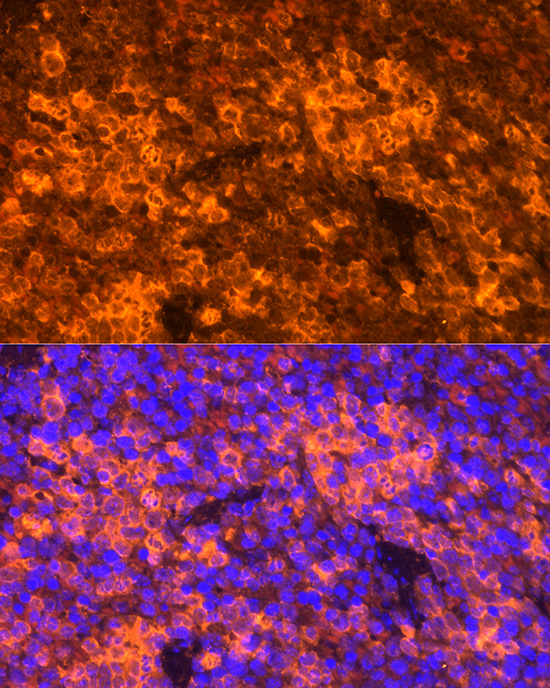
The antibody against CCL5/RANTES was raised in Rabbit using the recombinant fusion protein containing a sequence corresponding to amino acids 24-91 of human CCL5/RANTES (NP_002976.2) as the immunogen. The polyclonal antibody exists as a isotype IgG, by affinity purification. This antibody has been validated on WB, IF/ICC, ELISA.
| Cat.No | ADA-11433A | Clonality | Polyclonal |
|---|---|---|---|
| Host Species | Rabbit | Target Name | CCL5/RANTES |
| Target Synonyms | SISd; eoCP; SCYA5; RANTES; TCP228; D17S136E; SIS-delta; CCL5/RANTES | Form | Liquid |
| Species Reactivity | Human, Mouse, Rat | Isotype | IgG |
| Storage Buffer | 50% Glycerol, PBS with 0.02% sodium azide, pH7.3. | Purification Method | Affinity purification |
| Positive Samples | HL-60, Jurkat, Mouse spleen, Mouse thymus, Rat lung, Rat thymus | Application | ELISA, WB, IF/ICC |
| Immunogen Description | Recombinant fusion protein containing a sequence corresponding to amino acids 24-91 of human CCL5/RANTES (NP_002976.2). | Target Species | Human |
|---|---|---|---|
| Immunogen Sequence | SPYSSDTTPCCFAYIARPLPRAHIKEYFYTSGKCSNPAVVFVTRKNRQVCANPEKKWVREYINSLEMS | Uniprot ID | P13501 |
Uniprot Id
P13501
Target Species
Human
Target Name
CCL5
Target Full Name
C-C motif chemokine 5
Target Function
Chemoattractant for blood monocytes, memory T-helper cells and eosinophils. Causes the release of histamine from basophils and activates eosinophils. May activate several chemokine receptors including CCR1, CCR3, CCR4 and CCR5. One of the major HIV-suppressive factors produced by CD8+ T-cells. Recombinant RANTES protein induces a dose-dependent inhibition of different strains of HIV-1, HIV-2, and simian immunodeficiency virus (SIV). The processed form RANTES(3-68) acts as a natural chemotaxis inhibitor and is a more potent inhibitor of HIV-1-infection. The second processed form RANTES(4-68) exhibits reduced chemotactic and HIV-suppressive activity compared with RANTES(1-68) and RANTES(3-68) and is generated by an unidentified enzyme associated with monocytes and neutrophils. May also be an agonist of the G protein-coupled receptor GPR75, stimulating inositol trisphosphate production and calcium mobilization through its activation. Together with GPR75, may play a role in neuron survival through activation of a downstream signaling pathway involving the PI3, Akt and MAP kinases. By activating GPR75 may also play a role in insulin secretion by islet cells.
Target Subcellular Location
Secreted.
Target Protein Families
Intercrine beta (chemokine CC) family
Target Tissue Specificity
Expressed in the follicular fluid (at protein level). T-cell and macrophage specific.
Target Research Area
Immunology, Cardiovascular
Target Synonyms
Beta chemokine RANTES; Beta chemokine RANTES precursor; C C motif chemokine 5; CCL 5; CCL5; CCL5_HUMAN; Chemokine (C C motif) ligand 5; Chemokine CC Motif Ligand 5; D17S136E; EoCP; Eosinophil chemotactic cytokine; MGC17164; RANTES(4-68); Regulated upon activation normally T expressed and presumably secreted; SCYA 5; SCYA5; SIS delta; SIS-delta; SISd; Small inducible cytokine A5 (RANTES); Small inducible cytokine A5; Small inducible cytokine subfamily A (Cys Cys) member 5; Small-inducible cytokine A5; T cell specific protein p288; T cell specific protein RANTES; T cell specific RANTES protein; T cell-specific protein P228; T-cell-specific protein RANTES; TCP 228; TCP228
Target Background
This gene is one of several chemokine genes clustered on the q-arm of chromosome 17. Chemokines form a superfamily of secreted proteins involved in immunoregulatory and inflammatory processes. The superfamily is divided into four subfamilies based on the arrangement of the N-terminal cysteine residues of the mature peptide. This chemokine, a member of the CC subfamily, functions as a chemoattractant for blood monocytes, memory T helper cells and eosinophils. It causes the release of histamine from basophils and activates eosinophils. This cytokine is one of the major HIV-suppressive factors produced by CD8+ cells. It functions as one of the natural ligands for the chemokine receptor chemokine (C-C motif) receptor 5 (CCR5), and it suppresses in vitro replication of the R5 strains of HIV-1, which use CCR5 as a coreceptor. Alternative splicing results in multiple transcript variants that encode different isoforms.
Notification