-
Chinese (Simplified)
-
English
-
German
-
Korean
-
Spanish
Chinese (Simplified)
English
German
Korean
Spanish
Sign up for an account to enjoy easy online shopping and instant order tracking.
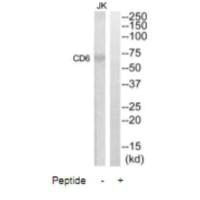
The antibody against CD6 was raised in rabbit using the Synthesized peptide derived from internal of Human CD6. as the immunogen. The antibody was affinity-purified from rabbit antiserum by affinity-chromatography using epitope-specific immunogen. This antibody has been validated on ELISA, WB.
$297.00
| Cat.No | ADC-40870A | Clonality | Polyclonal |
|---|---|---|---|
| Host Species | Rabbit | Target Name | CD6 |
| Form | Liquid | Species Reactivity | Human |
| Storage Buffer | PH 7.4, 0.02% sodium azide and 50% glycerol., 150mM NaCl, Rabbit IgG in phosphate buffered saline (without Mg2+ and Ca2+) | Purification Method | The antibody was affinity-purified from rabbit antiserum by affinity-chromatography using epitope-specific immunogen. |
| Application | ELISA, WB | Storage | Upon receipt |
| Immunogen Description | Synthesized peptide derived from internal of Human CD6. | Target Species | Human |
|---|---|---|---|
| Immunogen Sequence | Complete sequences for the immunogen, target protein, and peptides are available upon request. | Uniprot ID | P30203 |
Uniprot Id
P30203
Target Species
Human
Target Name
CD6
Target Full Name
T-cell differentiation antigen CD6
Target Function
Cell adhesion molecule that mediates cell-cell contacts and regulates T-cell responses via its interaction with ALCAM/CD166. Contributes to signaling cascades triggered by activation of the TCR/CD3 complex. Functions as costimulatory molecule; promotes T-cell activation and proliferation. Contributes to the formation and maturation of the immunological synapse. Functions as calcium-dependent pattern receptor that binds and aggregates both Gram-positive and Gram-negative bacteria. Binds both lipopolysaccharide (LPS) from Gram-negative bacteria and lipoteichoic acid from Gram-positive bacteria. LPS binding leads to the activation of signaling cascades and down-stream MAP kinases. Mediates activation of the inflammatory response and the secretion of pro-inflammatory cytokines in response to LPS.
Target Subcellular Location
Cell membrane; Single-pass type I membrane protein.; [Soluble CD6]: Secreted.
Target Tissue Specificity
Detected on thymocytes. Detected on peripheral blood T-cells. Detected on natural killer (NK) cells. Soluble CD6 is detected in blood serum (at protein level). Detected in spleen, thymus, appendix, lymph node and peripheral blood leukocytes. Expressed by
Target Synonyms
CD_antigen=CD6; CD6; CD6 antigen Tp120; CD6 molecule; CD6_HUMAN; FLJ44171; OX52; T cell differentiation antigen CD6; T-cell differentiation antigen CD6; T12; TP120
Target Background
This gene encodes a protein found on the outer membrane of T-lymphocytes as well as some other immune cells. The encoded protein contains three scavenger receptor cysteine-rich (SRCR) domains and a binding site for an activated leukocyte cell adhesion molecule. The gene product is important for continuation of T cell activation. This gene may be associated with susceptibility to multiple sclerosis (PMID: 19525953, 21849685). Multiple transcript variants encoding different isoforms have been found for this gene.
Notification