-
Chinese (Simplified)
-
English
-
German
-
Korean
-
Spanish
Chinese (Simplified)
English
German
Korean
Spanish
Sign up for an account to enjoy easy online shopping and instant order tracking.
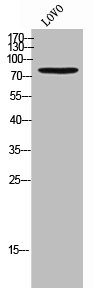
The antibody against CDH13 was raised in rabbit using the Synthesized peptide derived from the Internal region of Human T-cadherin. as the immunogen. This antibody exists as a non-conjugated isotype IgG. The antibody was affinity-purified from rabbit antiserum by affinity-chromatography using epitope-specific immunogen. This antibody has been validated on WB, IHC, IF, ELISA.
$167.00
| Cat.No | ADC-36688A | Clonality | Polyclonal |
|---|---|---|---|
| Host Species | Rabbit | Target Name | CDH13 |
| Form | Liquid | Species Reactivity | Human, Mouse, Rat |
| Isotype | IgG | Storage Buffer | 0.5% BSA and 0.02% sodium azide., Liquid in PBS containing 50% glycerol |
| Purification Method | The antibody was affinity-purified from rabbit antiserum by affinity-chromatography using epitope-specific immunogen. | Conjugate | Non-conjugated |
| Application | ELISA, IF, IHC, WB | Storage | Upon receipt |
| Immunogen Description | Synthesized peptide derived from the Internal region of Human T-cadherin. | Target Species | Human |
|---|---|---|---|
| Immunogen Sequence | Complete sequences for the immunogen, target protein, and peptides are available upon request. | Uniprot ID | P55290 |
Uniprot Id
P55290
Target Species
Human
Target Name
CDH13
Target Full Name
Cadherin-13
Target Function
Cadherins are calcium-dependent cell adhesion proteins. They preferentially interact with themselves in a homophilic manner in connecting cells; cadherins may thus contribute to the sorting of heterogeneous cell types. May act as a negative regulator of neural cell growth.
Target Subcellular Location
Cell membrane; Lipid-anchor, GPI-anchor.
Target Tissue Specificity
Highly expressed in heart. In the CNS, expressed in cerebral cortex, medulla, hippocampus, amygdala, thalamus and substantia nigra. No expression detected in cerebellum or spinal cord.
Target Synonyms
CAD13_HUMAN; Cadherin-13; CDH13; CDHH; H-cadherin; Heart cadherin; P105; T cad; T Cadherin; T-cad; T-cadherin; Truncated cadherin
Target Background
This gene encodes a member of the cadherin superfamily. The encoded protein is localized to the surface of the cell membrane and is anchored by a GPI moiety, rather than by a transmembrane domain. The protein lacks the cytoplasmic domain characteristic of other cadherins, and so is not thought to be a cell-cell adhesion glycoprotein. This protein acts as a negative regulator of axon growth during neural differentiation. It also protects vascular endothelial cells from apoptosis due to oxidative stress, and is associated with resistance to atherosclerosis. The gene is hypermethylated in many types of cancer. Alternative splicing results in multiple transcript variants encoding different isoforms.
Notification