-
Chinese (Simplified)
-
English
-
German
-
Korean
-
Spanish
Chinese (Simplified)
English
German
Korean
Spanish
Sign up for an account to enjoy easy online shopping and instant order tracking.
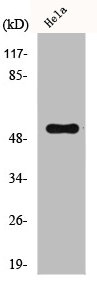
The antibody against CELF1 was raised in rabbit using the Synthesized peptide derived from the Internal region of Human CUG-BP1. as the immunogen. This antibody exists as a non-conjugated isotype IgG. The antibody was affinity-purified from rabbit antiserum by affinity-chromatography using epitope-specific immunogen. This antibody has been validated on WB, IHC, ELISA.
$167.00
| Cat.No | ADC-38934A | Clonality | Polyclonal |
|---|---|---|---|
| Host Species | Rabbit | Target Name | CELF1 |
| Form | Liquid | Species Reactivity | Human, Mouse, Rat |
| Isotype | IgG | Storage Buffer | 0.5% BSA and 0.02% sodium azide., Liquid in PBS containing 50% glycerol |
| Purification Method | The antibody was affinity-purified from rabbit antiserum by affinity-chromatography using epitope-specific immunogen. | Conjugate | Non-conjugated |
| Application | ELISA, IHC, WB | Storage | Upon receipt |
| Immunogen Description | Synthesized peptide derived from the Internal region of Human CUG-BP1. | Target Species | Human |
|---|---|---|---|
| Immunogen Sequence | Complete sequences for the immunogen, target protein, and peptides are available upon request. | Uniprot ID | Q92879 |
Uniprot Id
Q92879
Target Species
Human
Target Name
CELF1
Target Full Name
CUGBP Elav-like family member 1
Target Function
RNA-binding protein implicated in the regulation of several post-transcriptional events. Involved in pre-mRNA alternative splicing, mRNA translation and stability. Mediates exon inclusion and/or exclusion in pre-mRNA that are subject to tissue-specific and developmentally regulated alternative splicing. Specifically activates exon 5 inclusion of cardiac isoforms of TNNT2 during heart remodeling at the juvenile to adult transition. Acts as both an activator and repressor of a pair of coregulated exons: promotes inclusion of the smooth muscle (SM) exon but exclusion of the non-muscle (NM) exon in actinin pre-mRNAs. Activates SM exon 5 inclusion by antagonizing the repressive effect of PTB. Promotes exclusion of exon 11 of the INSR pre-mRNA. Inhibits, together with HNRNPH1, insulin receptor (IR) pre-mRNA exon 11 inclusion in myoblast. Increases translation and controls the choice of translation initiation codon of CEBPB mRNA. Increases mRNA translation of CEBPB in aging liver. Increases translation of CDKN1A mRNA by antagonizing the repressive effect of CALR3. Mediates rapid cytoplasmic mRNA deadenylation. Recruits the deadenylase PARN to the poly(A) tail of EDEN-containing mRNAs to promote their deadenylation. Required for completion of spermatogenesis. Binds to (CUG)n triplet repeats in the 3'-UTR of transcripts such as DMPK and to Bruno response elements (BREs). Binds to muscle-specific splicing enhancer (MSE) intronic sites flanking the alternative exon 5 of TNNT2 pre-mRNA. Binds to AU-rich sequences (AREs or EDEN-like) localized in the 3'-UTR of JUN and FOS mRNAs. Binds to the IR RNA. Binds to the 5'-region of CDKN1A and CEBPB mRNAs. Binds with the 5'-region of CEBPB mRNA in aging liver. May be a specific regulator of miRNA biogenesis. Binds to primary microRNA pri-MIR140 and, with CELF2, negatively regulates the processing to mature miRNA.
Target Subcellular Location
Nucleus. Cytoplasm. Note=RNA-binding activity is detected in both nuclear and cytoplasmic compartments.
Target Protein Families
CELF/BRUNOL family
Target Tissue Specificity
Ubiquitous.
Target Research Area
Epigenetics and Nuclear Signaling
Target Synonyms
50 kDa Nuclear polyadenylated RNA binding protein; 50 kDa nuclear polyadenylated RNA-binding protein; Bruno like 2; bruno like protein 2; Bruno-like protein 2; BRUNOL 2; BRUNOL2; CELF 1; CELF-1; celf1; CELF1 CUGBP, Elav like family member 1; CELF1_HUMAN; CUG BP and ETR 3 like factor 1; CUG BP; CUG BP1; CUG RNA binding protein; CUG triplet repeat RNA binding protein 1; CUG triplet repeat RNA-binding protein 1; CUG-BP; CUG-BP- and ETR-3-like factor 1; CUG-BP1; CUGBP 1; CUGBP and ETR3 like factor 1; CUGBP; CUGBP Elav like family member 1; CUGBP Elav-like family member 1; CUGBP1; Cytidine uridine guanosine binding protein 1; Deadenylation factor CUG BP; Deadenylation factor CUG-BP; Deadenylation factor CUGBP; EDEN BP; EDEN BP homolog; EDEN-BP; EDEN-BP homolog; embryo deadenylation element binding protein; embryo deadenylation element binding protein homolog; Embryo deadenylation element-binding protein homolog; hNab 50; hNab50; NAB 50; NAB50; NAPOR; Nuclear polyadenylated RNA binding protein 50 kD; Nuclear polyadenylated RNA binding protein; RNA binding protein BRUNOL 2; RNA binding protein BRUNOL2; RNA-binding protein BRUNOL-2
Target Background
Members of the CELF/BRUNOL protein family contain two N-terminal RNA recognition motif (RRM) domains, one C-terminal RRM domain, and a divergent segment of 160-230 aa between the second and third RRM domains. Members of this protein family regulate pre-mRNA alternative splicing and may also be involved in mRNA editing, and translation. This gene may play a role in myotonic dystrophy type 1 (DM1) via interactions with the dystrophia myotonica-protein kinase (DMPK) gene. Alternative splicing results in multiple transcript variants encoding different isoforms.
Notification