• Contact info@abtriva.com for inquiries and orders.
  • Chinese (Simplified)

  • English

  • German

  • Korean

  • Spanish

United States (English / $ USD)

Rabbit anti-Human cIAP1 Polyclonal Antibody

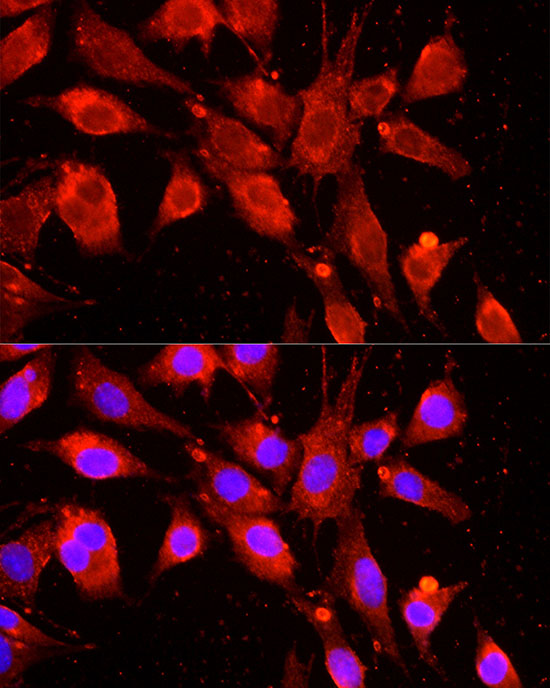
The antibody against cIAP1 was raised in Rabbit using the recombinant fusion protein containing a sequence corresponding to amino acids 331-420 of human cIAP1 (NP_001157.1) as the immunogen. The polyclonal antibody exists as a isotype IgG, by affinity purification. This antibody has been validated on IF/ICC, ELISA.

ADA-00980A

The antibody against cIAP1 was raised in Rabbit using the recombinant fusion protein containing a sequence corresponding to amino acids 331-420 of human cIAP1 (NP_001157.1) as the immunogen. The polyclonal antibody exists as a isotype IgG, by affinity purification. This antibody has been validated on IF/ICC, ELISA.

Number
Order Exclusive Products Now

Request a Quote
High Purity LevelsPrecision and ReliabilityCustomization Options

Specifications


Cat.No ADA-00980A ClonalityPolyclonal
Host SpeciesRabbitTarget NamecIAP1
Target SynonymsAPI1; MIHB; HIAP2; RNF48; cIAP1; Hiap-2; c-IAP1FormLiquid
Species ReactivityHuman, RatIsotypeIgG
Storage Buffer50% Glycerol, PBS with 0.02% sodium azide, pH7.3.Purification MethodAffinity purification
Positive SamplesHeLa, HepG2, Rat testisApplicationELISA, IF/ICC

Immunogen Information


Immunogen DescriptionRecombinant fusion protein containing a sequence corresponding to amino acids 331-420 of human cIAP1 (NP_001157.1).Target SpeciesHuman
Immunogen SequencePRCEFLIRMKGQEFVDEIQGRYPHLLEQLLSTSDTTGEENADPPIIHFGPGESSSEDAVMMNTPVVKSALEMGFNRDLVKQTVQSKILTTUniprot IDQ13490
Background Information
  • Uniprot Id

    Q13490

  • Target Species

    Human

  • Target Name

    BIRC2

  • Target Full Name

    Baculoviral IAP repeat-containing protein 2

  • Target Function

    Multi-functional protein which regulates not only caspases and apoptosis, but also modulates inflammatory signaling and immunity, mitogenic kinase signaling, and cell proliferation, as well as cell invasion and metastasis. Acts as an E3 ubiquitin-protein ligase regulating NF-kappa-B signaling and regulates both canonical and non-canonical NF-kappa-B signaling by acting in opposite directions: acts as a positive regulator of the canonical pathway and suppresses constitutive activation of non-canonical NF-kappa-B signaling. The target proteins for its E3 ubiquitin-protein ligase activity include: RIPK1, RIPK2, RIPK3, RIPK4, CASP3, CASP7, CASP8, TRAF2, DIABLO/SMAC, MAP3K14/NIK, MAP3K5/ASK1, IKBKG/NEMO, IKBKE and MXD1/MAD1. Can also function as an E3 ubiquitin-protein ligase of the NEDD8 conjugation pathway, targeting effector caspases for neddylation and inactivation. Acts as an important regulator of innate immune signaling via regulation of Toll-like receptors (TLRs), Nodlike receptors (NLRs) and RIG-I like receptors (RLRs), collectively referred to as pattern recognition receptors (PRRs). Protects cells from spontaneous formation of the ripoptosome, a large multi-protein complex that has the capability to kill cancer cells in a caspase-dependent and caspase-independent manner. Suppresses ripoptosome formation by ubiquitinating RIPK1 and CASP8. Can stimulate the transcriptional activity of E2F1. Plays a role in the modulation of the cell cycle.

  • Target Subcellular Location

    Cytoplasm. Nucleus. Note=Agents that induce either the extrinsic or intrinsic apoptotic pathways promote its redistribution from the nuclear compartment to the cytoplasmic compartment. Associated with the midbody in telophase cells, and found diffusely in the nucleus of interphase cells.

  • Target Protein Families

    IAP family

  • Target Tissue Specificity

    Present in many fetal and adult tissues. Mainly expressed in adult skeletal muscle, thymus, testis, ovary, and pancreas, low or absent in brain and peripheral blood leukocytes.

  • Target Synonyms

    API 1; API1; Apoptosis inhibitor 1; Baculoviral IAP repeat containing 2; Baculoviral IAP repeat containing protein 2; Baculoviral IAP repeat-containing protein 2; BIRC 2; BIRC2; BIRC2_HUMAN; C IAP1; C-IAP1; Cellular inhibitor of apoptosis 1; cellular inhibitor of apoptosis protein 1; cIAP 1; cIAP1; HIAP 2; HIAP-2; HIAP2; IAP 2; IAP homolog B; IAP-2; IAP2; Inhibitor of apoptosis protein 2; MIHB; NFR2 TRAF signalling complex protein; RING finger protein 48; RNF 48; RNF48; TNFR2 TRAF signaling complex protein 2; TNFR2-TRAF-signaling complex protein 2

  • Target Background

    The protein encoded by this gene is a member of a family of proteins that inhibits apoptosis by binding to tumor necrosis factor receptor-associated factors TRAF1 and TRAF2, probably by interfering with activation of ICE-like proteases. This encoded protein inhibits apoptosis induced by serum deprivation and menadione, a potent inducer of free radicals. Alternatively spliced transcript variants encoding different isoforms have been found for this gene.

Inquire Rabbit anti-Human cIAP1 Polyclonal Antibody Now


AbTriva respects your privacy and protects your personal data in accordance with AbTriva. For more information, please see our data protection statement. *

Notification