-
Chinese (Simplified)
-
English
-
German
-
Korean
-
Spanish

Chinese (Simplified)
English
German
Korean
Spanish
Sign up for an account to enjoy easy online shopping and instant order tracking.
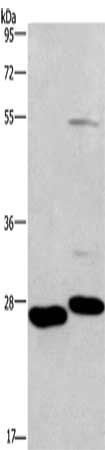
The antibody against CIDEC was raised in rabbit using the Fusion protein of Human CIDEC as the immunogen. This antibody exists as a non-conjugated isotype IgG, Antigen affinity purified. This antibody has been validated on ELISA, WB, IHC.
$299.00
| Cat.No | ADC-30341A | Clonality | Polyclonal |
|---|---|---|---|
| Host Species | Rabbit | Target Name | CIDEC |
| Form | Liquid | Species Reactivity | Human, Mouse, Rat |
| Isotype | IgG | Storage Buffer | 0.05% NaN3, 40% Glycerol., pH7.4 PBS |
| Purification Method | Antigen affinity purified | Conjugate | Non-conjugated |
| Application | ELISA, IHC, WB | Storage | Upon receipt |
| Immunogen Description | Fusion protein of Human CIDEC | Target Species | Human |
|---|---|---|---|
| Immunogen Sequence | Complete sequences for the immunogen, target protein, and peptides are available upon request. | Uniprot ID | Q96AQ7 |
Uniprot Id
Q96AQ7
Target Species
Human
Target Name
CIDEC
Target Full Name
Lipid transferase CIDEC
Target Function
Binds to lipid droplets and regulates their enlargement, thereby restricting lipolysis and favoring storage. At focal contact sites between lipid droplets, promotes directional net neutral lipid transfer from the smaller to larger lipid droplets. The transfer direction may be driven by the internal pressure difference between the contacting lipid droplet pair. Its role in neutral lipid transfer and lipid droplet enlargement is activated by the interaction with PLIN1. May act as a CEBPB coactivator in the white adipose tissue to control the expression of a subset of CEBPB downstream target genes, including SOCS1, SOCS3, TGFB1, TGFBR1, ID2 and XDH. When overexpressed in preadipocytes, induces apoptosis or increases cell susceptibility to apoptosis induced by serum deprivation or TGFB treatment. As mature adipocytes, that express high CIDEC levels, are quite resistant to apoptotic stimuli, the physiological significance of its role in apoptosis is unclear. May play a role in the modulation of the response to osmotic stress by preventing NFAT5 to translocate into the nucleus and activate its target genes expression.
Target Involvement
Lipodystrophy, familial partial, 5 (FPLD5)
Target Subcellular Location
Nucleus. Endoplasmic reticulum. Lipid droplet. Note=Diffuses quickly on lipid droplet surface, but becomes trapped and clustered at lipid droplet contact sites, thereby enabling its rapid enrichment at lipid droplet contact sites.
Target Tissue Specificity
Expressed mainly in adipose tissue, small intestine, heart, colon and stomach and, at lower levels, in brain, kidney and liver.
Target Research Area
Cell Biology
Target Synonyms
Cell death activator; Cell death activator CIDE-3; Cell death inducing DFFA like effector C; Cell death inducing DFFA like effector protein C; Cell death-inducing DFFA-like effector protein C; CIDE 3; CIDE C; CIDE3; CIDEC; CIDEC_HUMAN; Fat specific protein 27; Fat-specific protein FSP27 homolog; FLJ20871; FPLD5; FSP27
Notification