• Contact info@abtriva.com for inquiries and orders.
  • Chinese (Simplified)

  • English

  • German

  • Korean

  • Spanish

United States (English / $ USD)

Rabbit anti-Human Claudin-3 Monoclonal Antibody

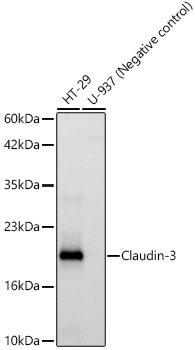
The antibody against Claudin-3 was raised in Rabbit using a synthetic peptide corresponding to a sequence within amino acids 121-220 of human Claudin-3 mAb (NP_001297.1) as the immunogen. The monoclonal antibody exists as a isotype IgG, by affinity purification. This antibody has been validated on WB, IHC-P, IF/ICC, ELISA.

ADA-15522A

The antibody against Claudin-3 was raised in Rabbit using a synthetic peptide corresponding to a sequence within amino acids 121-220 of human Claudin-3 mAb (NP_001297.1) as the immunogen. The monoclonal antibody exists as a isotype IgG, by affinity purification. This antibody has been validated on WB, IHC-P, IF/ICC, ELISA.

Number
Order Exclusive Products Now

Request a Quote
High Purity LevelsPrecision and ReliabilityCustomization Options

Specifications


Cat.No ADA-15522A ClonalityMonoclonal
Host SpeciesRabbitTarget NameClaudin-3
Target SynonymsRVP1; HRVP1; C7orf1; CPE-R2; CPETR2; Claudin-3FormLiquid
Species ReactivityHumanIsotypeIgG
Storage Buffer50% Glycerol, 0.05% BSA, PBS with 0.05% proclin300, pH7.3.Purification MethodAffinity purification
Positive SamplesHT-29ApplicationELISA, WB, IF/ICC, IHC-P

Immunogen Information


Immunogen DescriptionA synthetic peptide corresponding to a sequence within amino acids 121-220 of human Claudin-3 mAb (NP_001297.1).Target SpeciesHuman
Immunogen SequenceGVLFLLAALLTLVPVSWSANTIIRDFYNPVVPEAQKREMGAGLYVGWAAAALQLLGGALLCCSCPPREKKYTATKVVYSAPRSTGPGASLGTGYDRKDYVUniprot IDO15551
Background Information
  • Uniprot Id

    O15551

  • Target Species

    Human

  • Target Name

    CLDN3

  • Target Full Name

    Claudin-3

  • Target Function

    Plays a major role in tight junction-specific obliteration of the intercellular space, through calcium-independent cell-adhesion activity.

  • Target Involvement

    CLDN3 is located in the Williams-Beuren syndrome (WBS) critical region. WBS results from a hemizygous deletion of several genes on chromosome 7q11.23, thought to arise as a consequence of unequal crossing over between highly homologous low-copy repeat sequences flanking the deleted region.

  • Target Subcellular Location

    Cell junction, tight junction. Cell membrane; Multi-pass membrane protein.

  • Target Protein Families

    Claudin family

  • Target Research Area

    Signal Transduction

  • Target Synonyms

    CLDN3; C7orf1; CPETR2; Claudin-3; Clostridium perfringens enterotoxin receptor 2; CPE-R 2; CPE-receptor 2; Rat ventral prostate.1 protein homolog; hRVP1

  • Target Background

    Tight junctions represent one mode of cell-to-cell adhesion in epithelial or endothelial cell sheets, forming continuous seals around cells and serving as a physical barrier to prevent solutes and water from passing freely through the paracellular space. These junctions are comprised of sets of continuous networking strands in the outwardly facing cytoplasmic leaflet, with complementary grooves in the inwardly facing extracytoplasmic leaflet. The protein encoded by this intronless gene, a member of the claudin family, is an integral membrane protein and a component of tight junction strands. It is also a low-affinity receptor for Clostridium perfringens enterotoxin, and shares aa sequence similarity with a putative apoptosis-related protein found in rat.

Inquire Rabbit anti-Human Claudin-3 Monoclonal Antibody Now


AbTriva respects your privacy and protects your personal data in accordance with AbTriva. For more information, please see our data protection statement. *

Notification