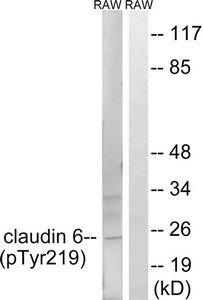
-
Chinese (Simplified)
-
English
-
German
-
Korean
-
Spanish
Chinese (Simplified)
English
German
Korean
Spanish
Sign up for an account to enjoy easy online shopping and instant order tracking.
The antibody against CLDN6 was raised in rabbit using the Peptide sequence around phosphorylation site of tyrosine 219 (T-K-N-Y(p)-V) derived from Human Claudin 6. as the immunogen. Antibodies were produced by immunizing rabbits with synthetic phosphopeptide and KLH conjugates. Antibodies were purified by affinity-chromatography using epitope-specific phosphopeptide. Non-phospho specific antibodies were removed by chromatogramphy usi This antibody has been validated on ELISA, WB.
$360.00
| Cat.No | ADC-42693A | Clonality | Polyclonal |
|---|---|---|---|
| Host Species | Rabbit | Target Name | CLDN6 |
| Target Synonyms | CLDN6; UNQ757/PRO1488; Claudin-6; Skullin | Form | Liquid |
| Species Reactivity | Human, Mouse | Storage Buffer | PH 7.4, 0.02% sodium azide and 50% glycerol., 150mM NaCl, Rabbit IgG in phosphate buffered saline (without Mg2+ and Ca2+) |
| Application | ELISA, WB | Storage | Upon receipt |
| Immunogen Description | Peptide sequence around phosphorylation site of tyrosine 219 (T-K-N-Y(p)-V) derived from Human Claudin 6. | Target Species | Human |
|---|---|---|---|
| Immunogen Sequence | Complete sequences for the immunogen, target protein, and peptides are available upon request. | Uniprot ID | P56747 |
Uniprot Id
P56747
Target Species
Human
Target Name
CLDN6
Target Full Name
Claudin-6
Target Function
Plays a major role in tight junction-specific obliteration of the intercellular space.; (Microbial infection) Acts as a receptor for hepatitis C virus (HCV) entry into hepatic cells.
Target Subcellular Location
Cell junction, tight junction. Cell membrane; Multi-pass membrane protein.
Target Protein Families
Claudin family
Target Tissue Specificity
Expressed in the liver, in peripheral blood mononuclear cells and hepatocarcinoma cell lines.
Target Synonyms
CLDN6; UNQ757/PRO1488; Claudin-6; Skullin
Target Background
Tight junctions represent one mode of cell-to-cell adhesion in epithelial or endothelial cell sheets, forming continuous seals around cells and serving as a physical barrier to prevent solutes and water from passing freely through the paracellular space. These junctions are comprised of sets of continuous networking strands in the outwardly facing cytoplasmic leaflet, with complementary grooves in the inwardly facing extracytoplasmic leaflet. This gene encodes a component of tight junction strands, which is a member of the claudin family. The protein is an integral membrane protein and is one of the entry cofactors for hepatitis C virus. The gene methylation may be involved in esophageal tumorigenesis. This gene is adjacent to another family member CLDN9 on chromosome 16.
Notification