-
Chinese (Simplified)
-
English
-
German
-
Korean
-
Spanish
Chinese (Simplified)
English
German
Korean
Spanish
Sign up for an account to enjoy easy online shopping and instant order tracking.
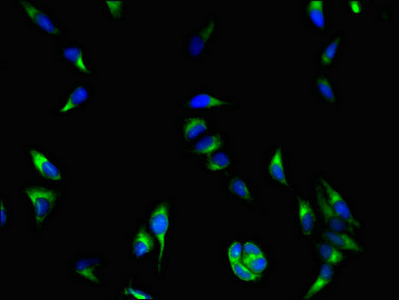
The antibody against COASY was raised in rabbit using the Recombinant Human Bifunctional coenzyme A synthase protein (453-546AA) as the immunogen. This antibody exists as a non-conjugated isotype IgG, purified by protein G with a purity greater than 95%. This antibody has been validated on ELISA, WB, IF.
$299.00
| Cat.No | ADC-14358A | Clonality | Polyclonal |
|---|---|---|---|
| Host Species | Rabbit | Target Name | COASY |
| Form | Liquid | Species Reactivity | Human |
| Isotype | IgG | Storage Buffer | 0.01M PBS, 0.03% Proclin 300; Constituents: 50% Glycerol, PH 7.4 |
| Purification Method | >95%, Protein G purified | Conjugate | Non-conjugated |
| Application | ELISA, IF, WB | Storage | Upon receipt |
| Immunogen Description | Recombinant Human Bifunctional coenzyme A synthase protein (453-546AA) | Target Species | Human |
|---|---|---|---|
| Immunogen Sequence | Complete sequences for the immunogen, target protein, and peptides are available upon request. | Uniprot ID | Q13057 |
Uniprot Id
Q13057
Target Species
Human
Target Name
COASY
Target Full Name
Bifunctional coenzyme A synthase
Target Function
Bifunctional enzyme that catalyzes the fourth and fifth sequential steps of CoA biosynthetic pathway. The fourth reaction is catalyzed by the phosphopantetheine adenylyltransferase, coded by the coaD domain; the fifth reaction is catalyzed by the dephospho-CoA kinase, coded by the coaE domain. May act as a point of CoA biosynthesis regulation.
Target Involvement
Neurodegeneration with brain iron accumulation 6 (NBIA6)
Target Subcellular Location
Cytoplasm. Mitochondrion matrix.
Target Protein Families
Eukaryotic CoaD family
Target Tissue Specificity
Expressed in all tissues examined including brain, heart, skeletal muscle, colon, thymus, spleen, kidney, liver, small intestine, placenta, lung and peripheral blood leukocyte. Lowest expression in peripheral blood leukocytes and highest in kidney and liv
Target Synonyms
Bifunctional coenzyme A synthase; Bifunctional phosphopantetheine adenylyl transferase/dephospho CoA kinase; CoA synthase; COASY; COASY_HUMAN; Coenzyme A synthase; Dephospho-CoA kinase; Dephospho-CoA pyrophosphorylase; Dephosphocoenzyme A kinase; DPCK; DPCOAK; NBP; Nucleotide binding protein; Pantetheine-phosphate adenylyltransferase; Phosphopantetheine adenylyltransferase / dephosphocoenzyme A kinase; pOV 2; POV-2; POV2; PPAT; UKR1
Target Background
Coenzyme A (CoA) functions as a carrier of acetyl and acyl groups in cells and thus plays an important role in numerous synthetic and degradative metabolic pathways in all organisms. In eukaryotes, CoA and its derivatives are also involved in membrane trafficking and signal transduction. This gene encodes the bifunctional protein coenzyme A synthase (CoAsy) which carries out the last two steps in the biosynthesis of CoA from pantothenic acid (vitamin B5). The phosphopantetheine adenylyltransferase domain of this bifunctional protein catalyzes the conversion of 4'-phosphopantetheine into dephospho-coenzyme A (dpCoA) while its dephospho-CoA kinase domain completes the final step by phosphorylating dpCoA to form CoA. Mutations in this gene are associated with neurodegeneration with brain iron accumulation (NBIA). Alternative splicing results in multiple isoforms.
Notification