-
Chinese (Simplified)
-
English
-
German
-
Korean
-
Spanish
Chinese (Simplified)
English
German
Korean
Spanish
Sign up for an account to enjoy easy online shopping and instant order tracking.
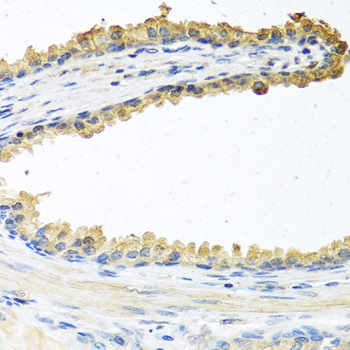
The antibody against COCH was raised in Rabbit using the recombinant fusion protein containing a sequence corresponding to amino acids 20-260 of human COCH (NP_001128530.1) as the immunogen. The polyclonal antibody exists as a isotype IgG, by affinity purification. This antibody has been validated on IHC-P, IF/ICC, ELISA.
| Cat.No | ADA-02962A | Clonality | Polyclonal |
|---|---|---|---|
| Host Species | Rabbit | Target Name | COCH |
| Target Synonyms | DFNA9; COCH5B2; DFNB110; COCH-5B2; COCH | Form | Liquid |
| Species Reactivity | Human | Isotype | IgG |
| Storage Buffer | 50% Glycerol, PBS with 0.02% sodium azide, pH7.3. | Purification Method | Affinity purification |
| Application | ELISA, IF/ICC, IHC-P |
| Immunogen Description | Recombinant fusion protein containing a sequence corresponding to amino acids 20-260 of human COCH (NP_001128530.1). | Target Species | Human |
|---|---|---|---|
| Uniprot ID | O43405 | Immunogen Sequence |
Uniprot Id
O43405
Target Species
Human
Target Name
COCH
Target Full Name
Cochlin
Target Function
Plays a role in the control of cell shape and motility in the trabecular meshwork.
Target Involvement
Deafness, autosomal dominant, 9 (DFNA9)
Target Subcellular Location
Secreted, extracellular space, extracellular matrix.
Target Tissue Specificity
Expressed in inner ear structures; the cochlea and the vestibule.
Target Synonyms
COCH; COCH5B2; UNQ257/PRO294Cochlin; COCH-5B2
Target Background
The protein encoded by this gene is highly conserved in human, mouse, and chicken, showing 94% and 79% amino acid identity of human to mouse and chicken sequences, respectively. Hybridization to this gene was detected in spindle-shaped cells located along nerve fibers between the auditory ganglion and sensory epithelium. These cells accompany neurites at the habenula perforata, the opening through which neurites extend to innervate hair cells. This and the pattern of expression of this gene in chicken inner ear paralleled the histologic findings of acidophilic deposits, consistent with mucopolysaccharide ground substance, in temporal bones from DFNA9 (autosomal dominant nonsyndromic sensorineural deafness 9) patients. Mutations that cause DFNA9 have been reported in this gene. Alternative splicing results in multiple transcript variants encoding the same protein. Additional splice variants encoding distinct isoforms have been described but their biological validities have not been demonstrated.
Notification