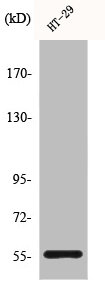
-
Chinese (Simplified)
-
English
-
German
-
Korean
-
Spanish
Chinese (Simplified)
English
German
Korean
Spanish
Sign up for an account to enjoy easy online shopping and instant order tracking.
The antibody against CYP2B6 was raised in rabbit using the Synthesized peptide derived from the Internal region of Human CYP2B6. as the immunogen. This antibody exists as a non-conjugated isotype IgG. The antibody was affinity-purified from rabbit antiserum by affinity-chromatography using epitope-specific immunogen. This antibody has been validated on WB, IHC, IF, ELISA.
$167.00
| Cat.No | ADC-38906A | Clonality | Polyclonal |
|---|---|---|---|
| Host Species | Rabbit | Target Name | CYP2B6 |
| Target Synonyms | 1 | Form | Liquid |
| Species Reactivity | Human | Isotype | IgG |
| Storage Buffer | 0.5% BSA and 0.02% sodium azide., Liquid in PBS containing 50% glycerol | Purification Method | The antibody was affinity-purified from rabbit antiserum by affinity-chromatography using epitope-specific immunogen. |
| Conjugate | Non-conjugated | Application | ELISA, IF, IHC, WB |
| Storage | Upon receipt |
| Immunogen Description | Synthesized peptide derived from the Internal region of Human CYP2B6. | Target Species | Human |
|---|---|---|---|
| Immunogen Sequence | Complete sequences for the immunogen, target protein, and peptides are available upon request. | Uniprot ID | P20813 |
Uniprot Id
P20813
Target Species
Human
Target Name
CYP2B6
Target Full Name
Cytochrome P450 2B6
Target Function
A cytochrome P450 monooxygenase involved in the metabolism of endocannabinoids and steroids. Mechanistically, uses molecular oxygen inserting one oxygen atom into a substrate, and reducing the second into a water molecule, with two electrons provided by NADPH via cytochrome P450 reductase (NADPH--hemoprotein reductase). Catalyzes the epoxidation of double bonds of arachidonoylethanolamide (anandamide) to 8,9-, 11,12-, and 14,15-epoxyeicosatrienoic acid ethanolamides (EpETrE-EAs), potentially modulating endocannabinoid system signaling. Hydroxylates steroid hormones, including testosterone at C-16 and estrogens at C-2. Plays a role in the oxidative metabolism of xenobiotics, including plant lipids and drugs. Acts as a 1,4-cineole 2-exo-monooxygenase.; Allele 2B6*9: Has low affinity for anandamide and can only produce 11,12 EpETrE-EAs.
Target Subcellular Location
Endoplasmic reticulum membrane; Peripheral membrane protein. Microsome membrane; Peripheral membrane protein.
Target Protein Families
Cytochrome P450 family
Target Tissue Specificity
Expressed in liver, lung and heart right ventricle.
Target Synonyms
1,4 cineole 2 exo monooxygenase; 11B1; CP2B6_HUMAN; CPB 6; CPB6; CYP 2B6; CYP IIB6; CYP2B; CYP2B6; CYP2B7; CYP2B7P; CYPIIB6; Cytochrome P450 2B6; Cytochrome P450 family 2 subfamily B; Cytochrome P450 family 2 subfamily B polypeptide 6; Cytochrome P450 IIB1; Cytochrome P450 phenobarbital inducible; Cytochrome P450 subfamily IIB (phenobarbital inducible); Cytochrome P450 subfamily IIB (phenobarbital inducible) polypeptide 6; Cytochrome P450 subfamily IIB polypeptide 6; EFVM; IIB1; P450; P450 IIB1; P450IIB1
Target Background
This gene, CYP2B6, encodes a member of the cytochrome P450 superfamily of enzymes. The cytochrome P450 proteins are monooxygenases which catalyze many reactions involved in drug metabolism and synthesis of cholesterol, steroids and other lipids. This protein localizes to the endoplasmic reticulum and its expression is induced by phenobarbital. The enzyme is known to metabolize some xenobiotics, such as the anti-cancer drugs cyclophosphamide and ifosphamide. Transcript variants for this gene have been described; however, it has not been resolved whether these transcripts are in fact produced by this gene or by a closely related pseudogene, CYP2B7. Both the gene and the pseudogene are located in the middle of a CYP2A pseudogene found in a large cluster of cytochrome P450 genes from the CYP2A, CYP2B and CYP2F subfamilies on chromosome 19q.
Notification