• Contact info@abtriva.com for inquiries and orders.
  • Chinese (Simplified)

  • English

  • German

  • Korean

  • Spanish

United States (English / $ USD)

Rabbit anti-Human DHRS2 Polyclonal Antibody

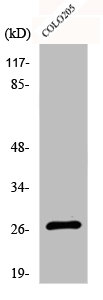
The antibody against DHRS2 was raised in rabbit using the Synthesized peptide derived from the Internal region of Human DHRS2. as the immunogen. This antibody exists as a non-conjugated isotype IgG. The antibody was affinity-purified from rabbit antiserum by affinity-chromatography using epitope-specific immunogen. This antibody has been validated on WB, ELISA.

ADC-38838A

The antibody against DHRS2 was raised in rabbit using the Synthesized peptide derived from the Internal region of Human DHRS2. as the immunogen. This antibody exists as a non-conjugated isotype IgG. The antibody was affinity-purified from rabbit antiserum by affinity-chromatography using epitope-specific immunogen. This antibody has been validated on WB, ELISA.

$167.00

Number
Order Exclusive Products Now

Request a Quote
High Purity LevelsPrecision and ReliabilityCustomization Options

Specifications


Cat.No ADC-38838A ClonalityPolyclonal
Host SpeciesRabbitTarget NameDHRS2
FormLiquidSpecies ReactivityHuman, Mouse
IsotypeIgGStorage Buffer0.5% BSA and 0.02% sodium azide., Liquid in PBS containing 50% glycerol
Purification MethodThe antibody was affinity-purified from rabbit antiserum by affinity-chromatography using epitope-specific immunogen.ConjugateNon-conjugated
ApplicationELISA, WBStorageUpon receipt

Immunogen Information


Immunogen DescriptionSynthesized peptide derived from the Internal region of Human DHRS2.Target SpeciesHuman
Immunogen SequenceComplete sequences for the immunogen, target protein, and peptides are available upon request.Uniprot IDQ13268
Background Information
  • Uniprot Id

    Q13268

  • Target Species

    Human

  • Target Name

    DHRS2

  • Target Full Name

    Dehydrogenase/reductase SDR family member 2, mitochondrial

  • Target Function

    Displays NADPH-dependent dicarbonyl reductase activity in vitro with 3,4-Hexanedione, 2,3-Heptanedione and 1-Phenyl-1,2-propanedione as substrates. No reductase activity is displayed in vitro with steroids, retinoids and sugars as substrates. Attenuates MDM2-mediated p53/TP53 degradation, leading to p53/TP53 stabilization and increased transcription activity, resulting in the accumulation of MDM2 and CDKN1A/p21.

  • Target Subcellular Location

    Mitochondrion matrix. Nucleus. Note=A minor fraction of the protein is translocated from the mitochondria to the nucleus, after cleavage of the targeting signal.

  • Target Protein Families

    Short-chain dehydrogenases/reductases (SDR) family

  • Target Tissue Specificity

    Widely expressed, with highest levels in liver and kidney, followed by heart, spleen, skeletal muscle and placenta. In hemopoietic cells, expressed in dendritic cells, but not in monocytes, macrophages, granulocytes, nor in B and T lymphocytes.

  • Target Research Area

    Signal Transduction

  • Target Synonyms

    DHRS2; SDR25C1; Dehydrogenase/reductase SDR family member 2; mitochondrial; EC 1.1.1.-; Dicarbonyl reductase HEP27; Protein D; Short chain dehydrogenase/reductase family 25C member 1

  • Target Background

    This gene encodes a member of the short-chain dehydrogenases/reductases (SDR) family, which has over 46, 000 members. Members of this family are enzymes that metabolize many different compounds, such as steroid hormones, prostaglandins, retinoids, lipids and xenobiotics. Alternative promoter use and alternative splicing results in multiple transcript variants.

Inquire Rabbit anti-Human DHRS2 Polyclonal Antibody Now


AbTriva respects your privacy and protects your personal data in accordance with AbTriva. For more information, please see our data protection statement. *

Notification