• Contact info@abtriva.com for inquiries and orders.
  • Chinese (Simplified)

  • English

  • German

  • Korean

  • Spanish

United States (English / $ USD)

Rabbit anti-Human DLL1 Polyclonal Antibody

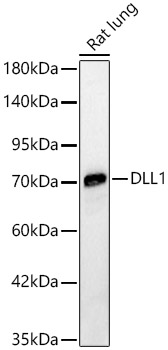
The antibody against DLL1 was raised in Rabbit using the recombinant fusion protein containing a sequence corresponding to amino acids 130-220 of human DLL1 (NP_005609.3) as the immunogen. The polyclonal antibody exists as a isotype IgG, by affinity purification. This antibody has been validated on WB, IHC-P, ELISA.

ADA-05757A

The antibody against DLL1 was raised in Rabbit using the recombinant fusion protein containing a sequence corresponding to amino acids 130-220 of human DLL1 (NP_005609.3) as the immunogen. The polyclonal antibody exists as a isotype IgG, by affinity purification. This antibody has been validated on WB, IHC-P, ELISA.

Number
Order Exclusive Products Now

Request a Quote
High Purity LevelsPrecision and ReliabilityCustomization Options

Specifications


Cat.No ADA-05757A ClonalityPolyclonal
Host SpeciesRabbitTarget NameDLL1
Target SynonymsDL1; Delta; DELTA1; NEDBAS; DLL1FormLiquid
Species ReactivityHuman, Mouse, RatIsotypeIgG
Storage Buffer50% Glycerol, PBS with 0.01% thimerosal, pH7.3.Purification MethodAffinity purification
Positive SamplesRat lungApplicationELISA, WB, IHC-P

Immunogen Information


Immunogen DescriptionRecombinant fusion protein containing a sequence corresponding to amino acids 130-220 of human DLL1 (NP_005609.3).Target SpeciesHuman
Immunogen SequenceDSPDDLATENPERLISRLATQRHLTVGEEWSQDLHSSGRTDLKYSYRFVCDEHYYGEGCSVFCRPRDDAFGHFTCGERGEKVCNPGWKGPYUniprot IDO00548
Background Information
  • Uniprot Id

    O00548

  • Target Species

    Human

  • Target Name

    DLL1

  • Target Full Name

    Delta-like protein 1

  • Target Function

    Transmembrane ligand protein of NOTCH1, NOTCH2 and NOTCH3 receptors that binds the extracellular domain (ECD) of Notch receptor in a cis and trans fashion manner. Following transinteraction, ligand cells produce mechanical force that depends of a clathrin-mediated endocytosis, requiring ligand ubiquitination, EPN1 interaction, and actin polymerisation; these events promote Notch receptor extracellular domain (NECD) transendocytosis and triggers Notch signaling through induction of cleavage, hyperphosphorylation, and nuclear accumulation of the intracellular domain of Notch receptors (NICD). Is required for embryonic development and maintenance of adult stem cells in many different tissues and immune systeme; the DLL1-induced Notch signaling is mediated through an intercellular communication that regulates cell lineage, cell specification, cell patterning and morphogenesis through effects on differentiation and proliferation. Plays a role in brain development at different level, namely by regulating neuronal differentiation of neural precursor cells via cell-cell interaction, most likely through the lateral inhibitory system in an endogenous level dependent-manner. During neocortex development, Dll1-Notch signaling transmission is mediated by dynamic interactions between intermediate neurogenic progenitors and radial glia; the cell-cell interactions are mediated via dynamic and transient elongation processes, likely to reactivate/maintain Notch activity in neighboring progenitors, and coordinate progenitor cell division and differentiation across radial and zonal boundaries. During cerebellar development, regulates Bergmann glial monolayer formation and its morphological maturation through a Notch signaling pathway. At the retina and spinal cord level, regulates neurogenesis by preventing the premature differentiation of neural progenitors and also by maintaining progenitors in spinal cord through Notch signaling pathway. Also controls neurogenesis of the neural tube in a progenitor domain-specific fashion along the dorsoventral axis. Maintains quiescence of neural stem cells and plays a role as a fate determinant that segregates asymmetrically to one daughter cell during neural stem cells mitosis, resulting in neuronal differentiation in Dll1-inheriting cell. Plays a role in immune systeme development, namely the development of all T-cells and marginal zone (MZ) B-cells. Blocks the differentiation of progenitor cells into the B-cell lineage while promoting the emergence of a population of cells with the characteristics of a T-cell/NK-cell precursor. Also plays a role during muscle development. During early development, inhibits myoblasts differentiation from the medial dermomyotomal lip and later regulates progenitor cell differentiation. Directly modulates cell adhesion and basal lamina formation in satellite cells through Notch signaling. Maintains myogenic progenitors pool by suppressing differentiation through down-regulation of MYOD1 and is required for satellite cell homing and PAX7 expression. During craniofacial and trunk myogenesis suppresses differentiation of cranial mesoderm-derived and somite-derived muscle via MYOD1 regulation but in cranial mesoderm-derived progenitors, is neither required for satellite cell homing nor for PAX7 expression. Also plays a role during pancreatic cell development. During type B pancreatic cell development, may be involved in the initiation of proximodistal patterning in the early pancreatic epithelium. Stimulates multipotent pancreatic progenitor cells proliferation and pancreatic growth by maintaining HES1 expression and PTF1A protein levels. During fetal stages of development, is required to maintain arterial identity and the responsiveness of arterial endothelial cells for VEGFA through regulation of KDR activation and NRP1 expression. Controls sprouting angiogenesis and subsequent vertical branch formation througth regulation on tip cell differentiation. Negatively regulates goblet cell differentiation in intestine and controls secretory fat commitment through lateral inhibition in small intestine. Plays a role during inner ear development; negatively regulates auditory hair cell differentiation. Plays a role during nephron development through Notch signaling pathway. Regulates growth, blood pressure and energy homeostasis.

  • Target Subcellular Location

    Apical cell membrane; Single-pass type I membrane protein. Cell junction, adherens junction. Membrane raft.

  • Target Tissue Specificity

    Expressed in heart and pancreas, with lower expression in brain and muscle and almost no expression in placenta, lung, liver and kidney.

  • Target Synonyms

    DLL1; UNQ146/PRO172; Delta-like protein 1; Drosophila Delta homolog 1; Delta1; H-Delta-1

  • Target Background

    DLL1 is a human homolog of the Notch Delta ligand and is a member of the delta/serrate/jagged family. It plays a role in mediating cell fate decisions during hematopoiesis. It may play a role in cell-to-cell communication.

Inquire Rabbit anti-Human DLL1 Polyclonal Antibody Now


AbTriva respects your privacy and protects your personal data in accordance with AbTriva. For more information, please see our data protection statement. *

Notification