-
Chinese (Simplified)
-
English
-
German
-
Korean
-
Spanish
Chinese (Simplified)
English
German
Korean
Spanish
Sign up for an account to enjoy easy online shopping and instant order tracking.
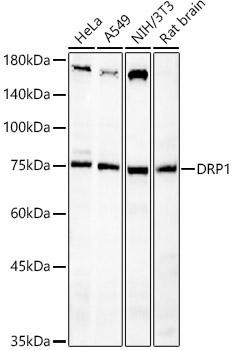
The antibody against DRP1 was raised in Rabbit using the recombinant fusion protein containing a sequence corresponding to amino acids 610-736 of human DRP1 (NP_036192.2) as the immunogen. The polyclonal antibody exists as a isotype IgG, by affinity purification. This antibody has been validated on WB, IF/ICC, ELISA.
| Cat.No | ADA-10379A | Clonality | Polyclonal |
|---|---|---|---|
| Host Species | Rabbit | Target Name | DRP1 |
| Target Synonyms | DLP1; DRP1; DVLP; EMPF; OPA5; EMPF1; DYMPLE; HDYNIV | Form | Liquid |
| Species Reactivity | Human, Mouse, Rat | Isotype | IgG |
| Storage Buffer | 50% Glycerol, PBS with 0.01% thimerosal, pH7.3. | Purification Method | Affinity purification |
| Positive Samples | HeLa, NIH/3T3, Rat brain, A549 | Application | ELISA, WB, IF/ICC |
| Immunogen Description | Recombinant fusion protein containing a sequence corresponding to amino acids 610-736 of human DRP1 (NP_036192.2). | Target Species | Human |
|---|---|---|---|
| Immunogen Sequence | IPIMPASPQKGHAVNLLDVPVPVARKLSAREQRDCEVIERLIKSYFLIVRKNIQDSVPKAVMHFLVNHVKDTLQSELVGQLYKSSLLDDLLTESEDMAQRRKEAADMLKALQGASQIIAEIRETHLW | Uniprot ID | O00429 |
Uniprot Id
O00429
Target Species
Human
Target Name
DNM1L
Target Full Name
Dynamin-1-like protein
Target Function
Functions in mitochondrial and peroxisomal division. Mediates membrane fission through oligomerization into membrane-associated tubular structures that wrap around the scission site to constrict and sever the mitochondrial membrane through a GTP hydrolysis-dependent mechanism. The specific recruitment at scission sites is mediated by membrane receptors like MFF, MIEF1 and MIEF2 for mitochondrial membranes. While the recruitment by the membrane receptors is GTP-dependent, the following hydrolysis of GTP induces the dissociation from the receptors and allows DNM1L filaments to curl into closed rings that are probably sufficient to sever a double membrane. Acts downstream of PINK1 to promote mitochondrial fission in a PRKN-dependent manner. Plays an important role in mitochondrial fission during mitosis. Through its function in mitochondrial division, ensures the survival of at least some types of postmitotic neurons, including Purkinje cells, by suppressing oxidative damage. Required for normal brain development, including that of cerebellum. Facilitates developmentally regulated apoptosis during neural tube formation. Required for a normal rate of cytochrome c release and caspase activation during apoptosis; this requirement may depend upon the cell type and the physiological apoptotic cues. Required for formation of endocytic vesicles. Proposed to regulate synaptic vesicle membrane dynamics through association with BCL2L1 isoform Bcl-X(L) which stimulates its GTPase activity in synaptic vesicles; the function may require its recruitment by MFF to clathrin-containing vesicles. Required for programmed necrosis execution. Rhythmic control of its activity following phosphorylation at Ser-637 is essential for the circadian control of mitochondrial ATP production.; Inhibits peroxisomal division when overexpressed.; Inhibits peroxisomal division when overexpressed.
Target Involvement
Encephalopathy due to defective mitochondrial and peroxisomal fission 1 (EMPF1)
Target Subcellular Location
Cytoplasm, cytosol. Golgi apparatus. Endomembrane system; Peripheral membrane protein. Mitochondrion outer membrane; Peripheral membrane protein. Peroxisome. Membrane, clathrin-coated pit. Cytoplasmic vesicle, secretory vesicle, synaptic vesicle membrane.
Target Protein Families
TRAFAC class dynamin-like GTPase superfamily, Dynamin/Fzo/YdjA family
Target Tissue Specificity
Ubiquitously expressed with highest levels found in skeletal muscles, heart, kidney and brain. Isoform 1 is brain-specific. Isoform 2 and isoform 3 are predominantly expressed in testis and skeletal muscles respectively. Isoform 4 is weakly expressed in b
Target Research Area
Cancer
Target Synonyms
DLP1; dnm1l; DNM1L_HUMAN; Dnm1p/Vps1p-like protein; dnml1; DRP1; DVLP; Dymple; Dynamin 1 like; Dynamin family member proline-rich carboxyl-terminal domain less; Dynamin like protein; Dynamin related protein 1; Dynamin-1-like protein; Dynamin-like protein 4; Dynamin-like protein; Dynamin-like protein IV; Dynamin-related protein 1; DYNIV 11; EMPF; EMPF1; FLJ41912; HdynIV; VPS1
Target Background
This gene encodes a member of the dynamin superfamily of GTPases. The encoded protein mediates mitochondrial and peroxisomal division, and is involved in developmentally regulated apoptosis and programmed necrosis. Dysfunction of this gene is implicated in several neurological disorders, including Alzheimer's disease. Mutations in this gene are associated with the autosomal dominant disorder, encephalopathy, lethal, due to defective mitochondrial and peroxisomal fission (EMPF). Alternative splicing results in multiple transcript variants encoding different isoforms.
Notification