-
Chinese (Simplified)
-
English
-
German
-
Korean
-
Spanish
Chinese (Simplified)
English
German
Korean
Spanish
Sign up for an account to enjoy easy online shopping and instant order tracking.
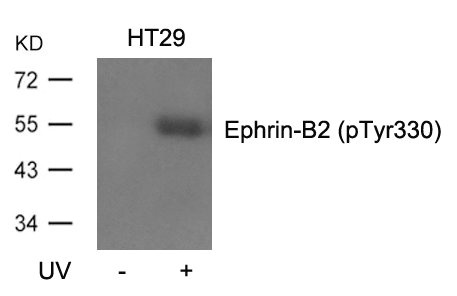
The antibody against EFNB2 was raised in rabbit using the Peptide sequence around phosphorylation site of tyrosine 330 (N-I-Y(p)-Y-K) derived from Human Ephrin-B2 as the immunogen. Antibodies were produced by immunizing rabbits with synthetic peptide and KLH conjugates. Antibodies were purified by affinity-chromatography using epitope-specific peptide. This antibody has been validated on ELISA, WB.
$360.00
| Cat.No | ADC-43238A | Clonality | Polyclonal |
|---|---|---|---|
| Host Species | Rabbit | Target Name | EFNB2 |
| Target Synonyms | EFNB2; EPLG5; HTKL; LERK5; Ephrin-B2; EPH-related receptor tyrosine kinase ligand 5; LERK-5; HTK ligand; HTK-L | Form | Liquid |
| Species Reactivity | Human, Mouse | Storage Buffer | PH 7.4, 0.02% sodium azide and 50% glycerol., 150mM NaCl, Supplied at 1.0mg/mL in phosphate buffered saline (without Mg2+ and Ca2+) |
| Purification Method | Antibodies were produced by immunizing rabbits with synthetic peptide and KLH conjugates. Antibodies were purified by affinity-chromatography using epitope-specific peptide. | Application | ELISA, WB |
| Storage | Upon receipt |
| Immunogen Description | Peptide sequence around phosphorylation site of tyrosine 330 (N-I-Y(p)-Y-K) derived from Human Ephrin-B2 | Target Species | Human |
|---|---|---|---|
| Immunogen Sequence | Complete sequences for the immunogen, target protein, and peptides are available upon request. | Uniprot ID | P52799 |
Uniprot Id
P52799
Target Species
Human
Target Name
EFNB2
Target Full Name
Ephrin-B2
Target Function
Cell surface transmembrane ligand for Eph receptors, a family of receptor tyrosine kinases which are crucial for migration, repulsion and adhesion during neuronal, vascular and epithelial development. Binds promiscuously Eph receptors residing on adjacent cells, leading to contact-dependent bidirectional signaling into neighboring cells. The signaling pathway downstream of the receptor is referred to as forward signaling while the signaling pathway downstream of the ephrin ligand is referred to as reverse signaling. Binds to receptor tyrosine kinase including EPHA4, EPHA3 and EPHB4. Together with EPHB4 plays a central role in heart morphogenesis and angiogenesis through regulation of cell adhesion and cell migration. EPHB4-mediated forward signaling controls cellular repulsion and segregation from EFNB2-expressing cells. May play a role in constraining the orientation of longitudinally projecting axons.; (Microbial infection) Acts as a receptor for Hendra virus and Nipah virus.
Target Subcellular Location
Cell membrane; Single-pass type I membrane protein. Cell junction, adherens junction.
Target Protein Families
Ephrin family
Target Tissue Specificity
Lung and kidney.
Target Synonyms
EFNB2; EPLG5; HTKL; LERK5; Ephrin-B2; EPH-related receptor tyrosine kinase ligand 5; LERK-5; HTK ligand; HTK-L
Target Background
This gene encodes a member of the ephrin (EPH) family. The ephrins and EPH-related receptors comprise the largest subfamily of receptor protein-tyrosine kinases and have been implicated in mediating developmental events, especially in the nervous system and in erythropoiesis. Based on their structures and sequence relationships, ephrins are divided into the ephrin-A (EFNA) class, which are anchored to the membrane by a glycosylphosphatidylinositol linkage, and the ephrin-B (EFNB) class, which are transmembrane proteins. This gene encodes an EFNB class ephrin which binds to the EPHB4 and EPHA3 receptors.
Notification