-
Chinese (Simplified)
-
English
-
German
-
Korean
-
Spanish
Chinese (Simplified)
English
German
Korean
Spanish
Sign up for an account to enjoy easy online shopping and instant order tracking.
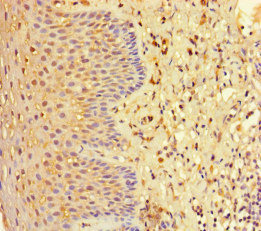
The antibody against EHD1 was raised in rabbit using the Recombinant Human EH domain-containing protein 1 protein (401-498AA) as the immunogen. This antibody exists as a non-conjugated isotype IgG, purified by protein G with a purity greater than 95%. This antibody has been validated on ELISA, WB, IHC.
$299.00
| Cat.No | ADC-14927A | Clonality | Polyclonal |
|---|---|---|---|
| Host Species | Rabbit | Target Name | EHD1 |
| Form | Liquid | Species Reactivity | Human |
| Isotype | IgG | Storage Buffer | 0.01M PBS, 0.03% Proclin 300; Constituents: 50% Glycerol, PH 7.4 |
| Purification Method | >95%, Protein G purified | Conjugate | Non-conjugated |
| Application | ELISA, IHC, WB | Storage | Upon receipt |
| Immunogen Description | Recombinant Human EH domain-containing protein 1 protein (401-498AA) | Target Species | Human |
|---|---|---|---|
| Immunogen Sequence | Complete sequences for the immunogen, target protein, and peptides are available upon request. | Uniprot ID | Q9H4M9 |
Uniprot Id
Q9H4M9
Target Species
Human
Target Name
EHD1
Target Full Name
EH domain-containing protein 1
Target Function
ATP- and membrane-binding protein that controls membrane reorganization/tubulation upon ATP hydrolysis. In vitro causes vesiculation of endocytic membranes. Acts in early endocytic membrane fusion and membrane trafficking of recycling endosomes. Recruited to endosomal membranes upon nerve growth factor stimulation, indirectly regulates neurite outgrowth. Plays a role in myoblast fusion. Involved in the unidirectional retrograde dendritic transport of endocytosed BACE1 and in efficient sorting of BACE1 to axons implicating a function in neuronal APP processing. Plays a role in the formation of the ciliary vesicle (CV), an early step in cilium biogenesis. Proposed to be required for the fusion of distal appendage vesicles (DAVs) to form the CV by recruiting SNARE complex component SNAP29. Is required for recruitment of transition zone proteins CEP290, RPGRIP1L, TMEM67 and B9D2, and of IFT20 following DAV reorganization before Rab8-dependent ciliary membrane extension. Required for the loss of CCP110 form the mother centriole essential for the maturation of the basal body during ciliogenesis.
Target Subcellular Location
Recycling endosome membrane; Peripheral membrane protein; Cytoplasmic side. Early endosome membrane; Peripheral membrane protein; Cytoplasmic side. Cell membrane; Peripheral membrane protein; Cytoplasmic side. Cell projection, cilium membrane; Peripheral membrane protein; Cytoplasmic side.
Target Protein Families
TRAFAC class dynamin-like GTPase superfamily, Dynamin/Fzo/YdjA family, EHD subfamily
Target Tissue Specificity
Highly expressed in testis.
Target Synonyms
CDABP0131; EH domain containing 1; EH domain-containing protein 1; EHD1; EHD1_HUMAN; FLJ42622; FLJ44618; H PAST; hPAST1; PAST; PAST homolog 1; PAST1; Testilin
Target Background
This gene belongs to a highly conserved gene family encoding EPS15 homology (EH) domain-containing proteins. The protein-binding EH domain was first noted in EPS15, a substrate for the epidermal growth factor receptor. The EH domain has been shown to be an important motif in proteins involved in protein-protein interactions and in intracellular sorting. The protein encoded by this gene is thought to play a role in the endocytosis of IGF1 receptors. Alternatively spliced transcript variants have been found for this gene.
Notification