-
Chinese (Simplified)
-
English
-
German
-
Korean
-
Spanish
Chinese (Simplified)
English
German
Korean
Spanish
Sign up for an account to enjoy easy online shopping and instant order tracking.
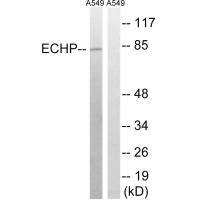
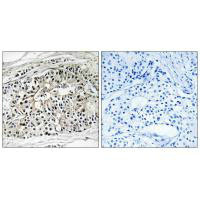
The antibody against EHHADH was raised in rabbit using the Synthesized peptide derived from internal of Human EHHADH. as the immunogen. The antibody was affinity-purified from rabbit antiserum by affinity-chromatography using epitope-specific immunogen. This antibody has been validated on ELISA, WB, IHC.
$297.00
| Cat.No | ADC-41052A | Clonality | Polyclonal |
|---|---|---|---|
| Host Species | Rabbit | Target Name | EHHADH |
| Target Synonyms | 3 hydroxyacyl CoA dehydrogenase antibody; 3 | Form | Liquid |
| Species Reactivity | Human | Storage Buffer | PH 7.4, 0.02% sodium azide and 50% glycerol., 150mM NaCl, Rabbit IgG in phosphate buffered saline (without Mg2+ and Ca2+) |
| Purification Method | The antibody was affinity-purified from rabbit antiserum by affinity-chromatography using epitope-specific immunogen. | Application | ELISA, IHC, WB |
| Storage | Upon receipt |
| Immunogen Description | Synthesized peptide derived from internal of Human EHHADH. | Target Species | Human |
|---|---|---|---|
| Immunogen Sequence | Complete sequences for the immunogen, target protein, and peptides are available upon request. | Uniprot ID | Q08426 |
Uniprot Id
Q08426
Target Species
Human
Target Name
EHHADH
Target Full Name
Peroxisomal bifunctional enzyme
Target Function
Peroxisomal trifunctional enzyme possessing 2-enoyl-CoA hydratase, 3-hydroxyacyl-CoA dehydrogenase, and delta 3, delta 2-enoyl-CoA isomerase activities. Catalyzes two of the four reactions of the long straight chain fatty acids peroxisomal beta-oxidation pathway. Optimal isomerase for 2,5 double bonds into 3,5 form isomerization in a range of enoyl-CoA species (Probable). Also able to isomerize both 3-cis and 3-trans double bonds into the 2-trans form in a range of enoyl-CoA species. With HSD17B4, catalyzes the hydration of trans-2-enoyl-CoA and the dehydrogenation of 3-hydroxyacyl-CoA, but with opposite chiral specificity. Regulates the amount of medium-chain dicarboxylic fatty acids which are essential regulators of all fatty acid oxidation pathways. Also involved in the degradation of long-chain dicarboxylic acids through peroxisomal beta-oxidation.
Target Involvement
Fanconi renotubular syndrome 3 (FRTS3)
Target Subcellular Location
Peroxisome.
Target Protein Families
Enoyl-CoA hydratase/isomerase family; 3-hydroxyacyl-CoA dehydrogenase family
Target Tissue Specificity
Liver and kidney. Strongly expressed in the terminal segments of the proximal tubule. Lower amounts seen in the brain.
Target Research Area
Metabolism
Target Synonyms
3 hydroxyacyl CoA dehydrogenase; 3,2 trans enoyl CoA isomerase; 3-hydroxyacyl-CoA dehydrogenase; ECHD; ECHP_HUMAN; EHHADH; Enoyl Coenzyme A; Enoyl Coenzyme A; hydratase/3 hydroxyacyl Coenzyme A dehydrogenase ; L 3 hydroxyacyl CoA dehydrogenase; L bifunctional protein; L bifunctional protein; peroxisomal; L PBE; LBFP; LBP; MGC120586; MS730; PBE; PBFE; Peroxisomal bifunctional enzyme; Peroxisomal enoyl CoA hydratase
Target Background
The protein encoded by this gene is a bifunctional enzyme and is one of the four enzymes of the peroxisomal beta-oxidation pathway. The N-terminal region of the encoded protein contains enoyl-CoA hydratase activity while the C-terminal region contains 3-hydroxyacyl-CoA dehydrogenase activity. Defects in this gene are a cause of peroxisomal disorders such as Zellweger syndrome. Two transcript variants encoding different isoforms have been found for this gene.
Notification